🌿 Ruzu Non-Alcoholic Herbal Bitters
Ruzu Non-Alcoholic Herbal Bitters is a natural health supplement specially formulated to:
- ✅ Promote general wellness
- ✅ Detoxify the body
- ✅ Support the treatment of various ailments
Made from a powerful blend of 100% organic and medicinal herbs, Ruzu is completely alcohol-free, making it ideal for:
- 👪 All age groups
- 🌱 Health-conscious individuals
- 🌿 Anyone seeking non-alcoholic herbal remedies
Whether you're looking to boost your vitality, cleanse your system, or support healing the natural way, Ruzu Bitters offers a trusted herbal solution.
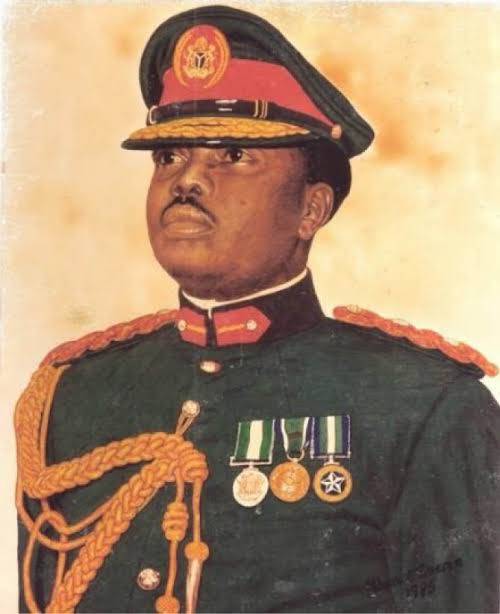
Michael Otuwe (retd.), a former orderly who witnessed the failed 1976 coup firsthand, has brought back new recollections of the assassination of former Head of State Murtala Muhammed fifty years later.
In a rare interview that was re-examined to commemorate the anniversary ten years ago, the retired soldier talks about his experiences during the civil war, how the charismatic leader nearly escaped his assailants, and the personal sacrifices that characterized years of close service to one of Nigeria’s most admired military leaders.
“I am an Igala man from Olamoboro Local Government of Kogi State,” Otuwe recounted in the interview with Daily Trust, recalling his entry into the military. I went to Ankpa Primary School and Ankpa Model Secondary School prior to enlisting in the army, which is the career I most loved.
He claims that on September 11, 1967, he joined the Nigerian Army at the Ikeja Military Cantonment in Lagos, where he received six months of training just before the start of the Nigerian Civil War.
“Incidentally, Murtala Ramat Mohammed was a Colonel and the Inspector of Signals at the time I was assigned to the Nigerian Army Signal Corps following the training,” he continued.
Otuwe claimed that Muhammad personally picked him due to his neatness and discipline.
“He told me that at our master parade, he saw how well-groomed I was in my army uniform. He remarked, “When I was a Lance Corporal, he chose me to be his orderly.
He clarified that he had worked closely with Muhammad in a number of positions, including during the civil war, when the late General was appointed the first General Officer Commanding of the Nigerian Army’s Second Division.
The General had three children during that time: Aisha, Zakari, and Fatima. Otuwe stated, “I worked with him till he was killed, and that was 11 years.”
Otuwe characterized Muhammad as a military leader who was both strategic and disciplined.
He was an organizer for the welfare of men. He was intelligent and diligent, and he put Nigeria first,” he remarked.
He recounted an instance in which they were surrounded by Biafran soldiers.
He made an amazing tactical move and withdrew, leaving even those of us with him perplexed. When many wanted to give up, he set out to fight and win so that Nigeria might remain a single nation.
Overcoming Ambushes
The former soldier described a number of ambushes he had come across throughout the conflict. We had a lot of ambushes and attacks, but one of the more memorable ones was when we were surrounded at Ukpo Junction in Abbagana, he stated. Many towns and cities were taken as a result of Murtala’s tactical move to withdraw and get ready for a defensive onslaught.
Following several actions, Otuwe continued, troops marched through Asaba and then to Idah in modern-day Kogi State in order to get ready for more offensives.
After a reorganization in 1968, General Murtala returned to Lagos as the Minister of Communications and the Inspector of Signals. In other words, he was working two jobs at once,” he said.
Otuwe talked about how his work had impacted his family, stating that his wife had become used to life in the military.
She was married to a soldier and had integrated herself into the system. He explained, “She knew we were off duty when she saw us at home.”
Because of his hectic schedule, he noted, his kids hardly ever saw him.
“I left home at dawn and returned late at night, so most of my kids almost forgot me,” Otuwe wrote.
Price monitoring and covert visits
Otuwe also described how Muhammad concealed himself in order to keep an eye on Lagos’s market rates.
He claimed that at one point, he was followed to evaluate prices and the growing cost of things by his ADC, Lieutenant Akintunde Akinterinwa.
Wearing a tracksuit, a face cap, and dark goggles, he rode a horse to a filling station, got off, tied it, and went into the marketplaces of Sangross (Lagos Island), Ajegunle, and then Agege. I was posing as a window shopper while the ADC acted as though we were not together and that they were writing the prices. People were more disciplined back then, and everyone waited for their turn, so a market woman advised him to give other purchasers a chance. Meat and commodities arrived in ships after two weeks. The flesh was labeled “Murtala Meat” by others.
Orderly, Murtala Muhammad, and Michael Otuwe
Assassination Day
When questioned about what transpired on the day of Murtala’s murder, Otuwe recounted, “He was killed on July 29, 1976 (begins to cry).” He held power from July 29, 1975, to February 13, 1976, for a total of six months. Before General Gowon left Dodan Barracks, he allowed the residence to be repaired and his personal belongings to be carefully removed rather than thrown out, demonstrating his great character. His absence of pilot cars, motorbike outriders, armed military personnel, and security escorts was the reason he was commuting from Ikoyi. He only drove the official Mercedes-Benz, which was flying two flags: the military flag on the right and the national flag on the left. That fateful day, we went by the Federal Secretariat in Ikoyi, which was coated in zinc and undergoing renovations.
When we arrived at Alagbgon Junction, the traffic cop failed to see the flags and would have let the cars heading our way continue, but instead he stopped the five or six cars ahead of us. I then noticed some people in Agbada (Babanriga), and when they raised them, they brandished AK-47 rifles and opened fire on us. A man wearing a mask had already struck Sergeant Adamu Michika, the driver, in the head and felt the armrest where the suit bag with the General’s mufti was located. I landed on the driver after taking cover.
Additionally, the General and the ADC sought refuge. As the assassins departed and made their way to the National Broadcasting Corporation, Radio House, to declare the takeover, one of the Majors noticed that the Major shouted and informed his colleagues that they were still alive when the ADC opened the door to assist the General. As a result, they turned, hurried back, and fired at us. After being shot in the arm and hip, I was the only one who survived.
The soldiers were pursued by General Murtala’s loyalist troops, who led us to the mortuary. I came out of my coma when the discomfort and the air conditioner’s breeze roused me up. I raised my hand, and a mortuary attendant saw it. He called a doctor, who confirmed that I was still alive. I was then taken to Dodan Barracks and a hospital on Awolowo Road in Ikoyi.
Otuwe spoke of his recuperation from the incident, saying, “I returned to work with the Nigerian Army Signal Corps after six months of recuperation. There I collaborated with Generals Tanko Ayuba, Raji Rasaki, and Adenaju.
When asked if he had ever been honored, the former soldier said, “No, not at all.”
Otuwe disclosed his living arrangement during the interview, saying, “I currently reside in a rented two-bedroom house in Maraba, Nasarawa State. Not to mention a home number, the street is nameless. However, I work in Maitama at Riskua Murtala Muhammad’s office.
Otuwe remembered that on December 31, 1999, he retired as a Master Warrant Officer.
Otuwe responded, “No, no, no, not at all,” when asked if he ever regretted serving in the Nigerian Army.