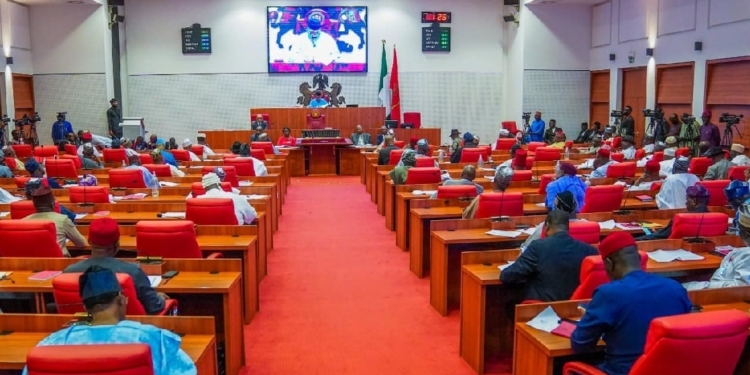
The envelope budgeting system for security and intelligence organizations was criticized by Sen. Yahaya Abdullahi, the chairman of the Senate Committee on National Security and Intelligence, on Wednesday.
Abdullahi voiced his concerns when Mohammed Sanusi, the Permanent Secretary, Special Services, Office of the National Security Adviser, addressed the budget defense committee.
“The purpose of the meeting was to review the budgetary provisions that would support the operations of the security and intelligence community for the fiscal year 2026,” he stated.
Remembering that President Bola Tinubu recently proclaimed a national security emergency, Abdullahi stated that the committee felt that funding for the intelligence community was essential.
He stated, “This is to make sure that it is in line with the difficulties that the country is facing.”
According to the senator, security agencies must be adequately funded in order to operate at their best and handle the thousands of new security threats to national stability.
The security and intelligence agency’s budget, he said, “is still subject to the vagaries of the envelope system of budgeting rather than on genuine needs and requirements, which is disheartening.”
Inappropriate, according to the member, was the 2024 and 2025 budgets’ non-release or partial release of capital funds designated for security services.
“This has undoubtedly had a very detrimental effect on their ability to acquire supplies and cutting-edge security equipment, as well as their operational capabilities,” he stated.
Abdullahi emphasized that the National Assembly must give the intelligence community the tools they need to protect the country, its residents, and their belongings.
The security and intelligence community’s timely appearance before the committee was praised by Sen. Orji Kalu (APC-Abia), a committee member.
“In the past, some invitees—particularly some ministers—have not kept to the scheduled times, showing up hours late and making a variety of excuses,” he stated.
“These delays have a detrimental impact on our work, particularly during this crucial budgetary period,” he stated.
While acknowledging that budget discussions are major issues, Kalu stated that “delays hinder our ability to perform our constitutional duties effectively.”
“I strongly advocate for the preservation of this culture of timeliness and deference to institutional procedures.”
Speaking as well, Mohammed Sanusi, Permanent Secretary, Special Services, Office of the National Security Adviser, stated that the brief addressed the central offices of the Office of the National Security Adviser.
The National Center for Control of Small Arms and Light Weapons, the National Cyber Security Coordination Center, the National Counter Terrorism Center, and Presidential Amnesty Programs are among the centers, he said.
Sanusi stated that using improved intelligence and community-based tactics to combat terrorism, banditry, and kidnapping was the intelligence community’s primary emphasis area for the current fiscal year.
It is important to highlight that the securities’ operations and activities during the 2025 fiscal year are not without difficulties.
According to him, “the envelope system of budgeting is one of the major challenges that the intelligence community faced in implementing the 2025 budget.”
According to Sanusi, the intelligence community’s ability to allocate resources was severely limited by the envelope system.
“There are irregular releases of the foreign service personnel shortfall, non-implementation of the release of the 2025 capital appropriation, and irregular releases of the overhead cost,” he said.
Therefore, he advocated for the supplemental budget to provide the intelligence committee with sufficient funding.
This is to guarantee a prompt and efficient reaction to matters pertaining to national security. We all concur that without sufficient security, no country can develop,” Sanusi stated.
The heads of federal government-owned Ministries, Departments, and Agencies (MDAs) were also criticized by the Senate on Wednesday by its National Security and Intelligence committee for their propensity to arrive late to committee meetings.
The heads of the various security intelligence organizations were complimented, nevertheless, for consistently showing up on time for such important meetings.
The National Security and Intelligence committee, which met with the Director-General of the Department of State Services (DSS), the National Security Adviser (NSA), and Nuhu Ribadu during the budget defense session, made harsh comments to agency heads who enjoy attending various standing committee engagements lately.
Senator Orji Uzor Kalu (Abia North) expressed his disgust with the trend of most agency chiefs arriving late for the budget defense session, saying that the Senate would no longer put up with it.
He said that the people most guilty of the late-coming attitude were former serving senators or members of the National Assembly who were appointed to the executive branch of government.
“We are pleased that the heads of the various national security and intelligence agencies showed up for the budget defense session before 11:00 am, which is when the interface is supposed to start,” he said.
But this isn’t the case for many of the other agency chiefs, especially those who are former members of the National Assembly or senators.
This is complete nonsense since all parties need to treat this budgetary time with the necessary seriousness.
“The people who are always late for committee assignments like to tell lies about their presidential engagement at the Villa, which are lies to us here.”
In agreement with Kalu’s warning, the committee’s chairman, Senator Yahaya Abdullahi (Kebbi North), stated that all impacted agency heads should consider it as a wake-up call.
The House of Representatives’ National Security and Intelligence Committee has also advocated for more financing for intelligence collection organizations in order to combat national insecurity.
Rep. Ahmad Satomi (APC-Borno), the committee’s chairman, made the request at Wednesday’s 2026 budget defense session in Abuja.
The congressman also urged the legislature and executive branch to work together more closely in order to improve Nigeria’s security framework.
In line with the stance previously expressed by President Bola Tinubu during his presentation of the ₦58.18 trillion 2026 Appropriation Bill to the National Assembly, he asserts that national security continues to be the cornerstone of growth.
He stated that ₦5.41 trillion was assigned to infrastructure, ₦3.56 trillion to defense and security, ₦3.52 trillion to education, and ₦2.48 trillion to health.
N664,119,740 was allotted to the intelligence subsector, which includes the Office of the National Security Adviser (NSA) and its agencies, the Department of State Services (DSS), the National Intelligence Agency (NIA), the Presidential Air Fleet, and the National Institute for Security Studies, for their capital, personnel, and overhead expenses out of the N5.42 trillion.
The entire proposed overhead cost is N131,273,507,85, the total proposed capital expenditure is N286,904,549,354, and the staff cost for all intelligence-related agencies in 2026 is N245,941,663,329.
“These allocations are very appalling; if we look at the releases for the 2025 budget implementation, or at least the ones we are aware of, there is nothing at all to imply that the president prioritizes security and intelligence.
“If the main goal of governance is, in fact, to provide welfare and security, then releases to the security sector should not be handled carelessly.
Therefore, he continued, “this committee is making a passionate appeal to our dear president to please look into the funding of the agencies in the intelligence sector, enhance them, and prioritise them.”
Satomi noted that the committee visited the DSS training schools in Bauchi, Lagos, and Enugu in 2024 and was disappointed by the poor condition of the facilities in each school.
“What we saw cannot honestly provide our men and women who are giving their lives for the service of our beloved nation with world-class technical, psychological, and sociological capabilities,” he said.
As is the case with police and military training institutes, he requested the president to order that the training institutions be allocated distinct budgetary heads and that sufficient resources be provided to operate them.
According to the Permanent Secretary, Special Services in the Office of National Security Adviser, the envelop system of budgeting imposed significant limitations on the distribution of resources to the intelligence community.
He said that the community was further limited by the erratic release of overseas service personnel shortfall for 2024 as a result of the FX differential, the erratic release of overhead costs, and the execution of the 2025 authorized overhead cost releases.
“Difficulties included failure to release capital allocation, high exchange rates, insufficient operational vehicles for successful and efficient covert and overt operations, and increased foreign exchange costs for maintaining the Presidential Air Fleet overseas rather than at home.”
In order to guarantee prompt and efficient action to matters of national security, we humbly ask that the intelligence community get sufficient money through a supplemental budget.
Without proper security, no country can develop, we all agreed.
“I want to emphasize and restate that the intelligence community consistently reassures the entire country of its dedication to openness, responsibility, and efficient resource management by making sure that the budgetary provisions are in line with the government’s overall security goals,” he said.
As ONSA requests additional cash to address insecurity
To enable prompt and efficient reaction to threats to national security and other challenges, Nigeria’s security and intelligence community has called for a special and supplemental budget.
Mohammed Sanusi, Permanent Secretary, Special Services, Office of National Security Adviser (ONSA), made the plea Wednesday before the House of Representatives Committee on National Security and Intelligence during a budget defense session.
He claimed that this is made much more relevant by President Bola Tinubu’s recent proclamation of a State of Emergency on National Security.
No country can develop without sufficient security, he emphasized.
The Office of National Security Adviser and its Centers, including the Presidential Amnesty Programme [PAP], the National Cybersecurity Coordination Center (NCCC), the National Center for the Control of Small Arms and Light Weapons (NCCSA&LW), and the National Counterterrorism Center (NCT), were discussed in his brief.
The Presidential Air Fleet (PAF), the National Institute for Security Studies (NISS), the Department of State Services (DSS), and the National Intelligence Agency (NIA) were also covered.
He stated that the fight against terrorism, banditry, and kidnapping through improved intelligence and community-based tactics, as well as the protection of vital infrastructure to guarantee food and economic security, the protection of vital infrastructure for oil and gas to boost oil production, maritime safety, and border security, are among the intelligence community’s main priorities for the current fiscal year 2026.
Other factors include improving sufficient cybersecurity, maintaining a positive and manageable security level throughout the Three Arms Zone, the entire Federal Capital Territory, and the nation as a whole, developing manpower and capacity to handle new security issues, such as the spread of small arms and light weapons throughout the West African corridor, emerging transnational crimes, and the effects of political instability in the contiguous West African nations.
According to him, one of the main obstacles the Intelligence Community had when implementing the 2025 Budget was the envelope system of budgeting, which created significant limitations on the Intelligence Community’s ability to allocate resources.
He added that the shortage of foreign service workers for 2024 as a result of the FX disparity, the non-implementation of the releases of the 2025 allotted overhead cost, and the irregular release of overhead costs are the others.
The non-release of capital allocation, the high exchange rate because nearly all service level agreements are in US dollars, the lack of operational vehicles for effective and efficient overt and covert operations, and the higher foreign exchange costs associated with maintaining the Presidential Air Fleet overseas rather than at the hangar are additional challenges, he said.
The Intelligence Community has consistently reassured this Committee and the entire National Assembly of its dedication to openness, responsibility, and efficient resource management by making sure that the budgetary provisions are in line with the government’s overarching security goals. I would like to reiterate this to the Distinguished Members.
Ultimately, the Intelligence Community recognized and expressed gratitude to Mr.
For his dedication and commitment to restoring peace and security to our communities, we are grateful to President Bola Ahmed Tinubu, GCFR. He added, “We continue to appreciate the support and understanding from the National Assembly and its leadership.
The funding for the intelligence sub-sector is pitiful, according to Engr. Ahmad Satomi, chairman of the House Committee on National Security and Intelligence.
The President’s recognition of the intelligence subsector’s importance in the broader effort to maintain a stable national security in his speech also pleased me. He stated in his 2026 budget speech that “Our administration is resetting the national security architecture and establishing a new national counterterrorism doctrine — a holistic redesign anchored on unified command, intelligence gathering, community stability, and counter-insurgency.”… We will approach terrorism and other violent acts quite differently as a result of this new doctrine.
However, the proposed budget for 2026 allots 5.41 trillion naira for defense and security. The Department of State Services, the National Intelligence Agency, the Presidential Air Fleet, the Office of the NSA and its Agencies, and the National Institute for Security Studies are all part of the intelligence subsector, which has been given N664,119,740 for personnel, overhead, and capital expenditures in 2026. The overall proposed capital expenditure for 2026 is N286,904,549,354, the total proposed overhead cost is N131,273,507,85, and the staff cost for all intelligence agencies is N245,941,663,329, according to further breakdown.
“It appears that the president’s statement to the Joint Session of the National Assembly on December 19, 2025, did not align with these extremely poor allocations.
Furthermore, based on the releases for the implementation of the 2025 budget, or at least the ones that we are aware of, there is no indication whatsoever that the president places a high priority on security and intelligence. If providing welfare and security is, in fact, the main goal of governance, then releases to the security sector shouldn’t be taken lightly, as one might think.
As a result, Satomi stated, “This Committee is fervently urging our dear president to please investigate the funding of the agencies in the intelligence sector, enhance them, and give them priority.”
President Bola Tinubu, he pointed out, highlighted the importance of national security as the cornerstone of economic expansion and stability, underscoring the government’s primary duty as stipulated in section 14 (2b) of the Federal Republic of Nigeria constitution.
He claimed that if the legislative and the administration do not recognize and respect one another’s constitutional obligations and view themselves as partners and stakeholders in the Nigerian project, this cannot be accomplished.
He said it is counterproductive and a bad wind that does no good to the nation when security and intelligence services see the legislature as intrusive outsiders whenever legislative committees attempt to conduct legislative oversight of the security sector.
Through its elected representatives, oversight enables the Nigerian people engage in security governance; it does not imply animosity, hatred, or witch hunts. This fosters public confidence and admiration for our security personnel and guarantees openness, responsibility, and cost-effectiveness in the implementation of government initiatives, plans, and regulations in the field,” he stated.
The opposition of certain agencies to the responsibilities of legislative scrutiny, he said, was unfortunate.
“I dare say that the members and leadership of standing committees that supervise security and intelligence organizations shouldn’t have access to confidential information. As esteemed members of the National Assembly, we are obligated to uphold the oaths of membership and allegiance outlined in the constitution’s seventh schedule.
In order for us to fulfill the government’s core duty of providing welfare and security to all Nigerians, I hereby urge the impacted agencies to adopt a new mindset and work together as partners in nation-building. It cannot be done by any one branch of government alone,” he stated.
He mentioned that in order to improve the security and intelligence sector’s efficacy and efficiency, the National Assembly passed a number of laws.
He anticipated that the Committee on National Security and Intelligence would continue to work with all pertinent parties, especially those who are responsible for carrying out the security and intelligence sector’s legislative body, to make sure that all provisions are carried out in order to fulfill the legislative intent behind their enactment.
This committee visited the Department of State Services’ training schools in Bauchi, Lagos, and Enugu in 2024. Additional visits are planned to the remaining schools in Kaduna, as well as the projected institutions in Kogi and Cross River States. We also went to the NIA’s Lagos training academy.
We were demoralized by the poor condition of the facilities in every school we visited since, in all honesty, we could not provide our men and women who are giving their lives in defense of our dear nation with top-notch technical, psychological, and sociological talents.
As with the Armed Forces and Police Training Institutes, our committee urges our beloved president to order that these training institutions receive distinct financial heads in the budget and that sufficient funding be provided to operate them.
During today’s discussion of the 2026 budget proposal, honorable colleagues, ladies, and gentlemen, this committee would like to reassure you and all Nigerians that the House of Representatives is totally committed to helping the intelligence sector’s agencies fulfill their mandates.
“We should work together and complement each other in our institutional efforts to create a safe, secure, and conducive country where Nigerians and foreign residents can live with pride and conduct their lawful businesses,” he stated.
Additionally, Justice Minister and Attorney-General of the Federation Lateef Fagbemi stated that the Federal Government of Nigeria’s (FGN) implementation of justice sector reforms had been negatively impacted by the federal ministry’s yearly budgets’ lack of approved cash and insufficient funding.
In a presentation to the House of Representatives Committee on Justice on Wednesday in Abuja, he made this claim on the Federal Ministry of Justice’s 2026 Budget Defense.
“The Ministry’s mandate and engagements are focused on attaining the goals and initiatives outlined in the National Policy on Justice 2024 and its Strategic Plan 2023-2027,” he told the House Committee.
The goals and initiatives, he added, are in line with the Renewed Hope Agenda, which is the present administration’s blueprint for the justice sector (legal and judicial changes).
Nonetheless, the Minister bemoaned the fact that the ministry’s ability to provide the public with essential projects and services is being negatively impacted by both the delayed receipt of funds and the insufficient budgetary allocation to the ministry.
He cited asset recovery, financial management, criminal justice and counterterrorism, and removal from the Financial Action Task Force’s (FATF) grey list as some of the major accomplishments in the ministry’s ongoing justice reforms.
According to him, only N6,675,702.827.32 (out of N7,499.524.027) was given to the Ministry as overhead costs for 10 months, which is an 82% performance rate.
In addition, the Ministry was given a warrant for capital projects of N869.630.896.30 out of N6,749.616.425, which is only 12% of the entire capital budget. Unfortunately, even this 12% was not guaranteed by collateral.
The Ministry did not receive any funds for its capital projects for 2025, he continued, adding that this is not a unique circumstance for the ministry.
He stated that the federal ministry’s 2026 budget plan allocated N23,680,142,209.50, which was divided among capital, overhead, and staff expenses.
In order to make sure that the shortage of funding does not impede reforms in the judicial system, the House panel will thoroughly examine the Ministry’s and its agencies’ proposed budget, according to Hon. Olumide Osoba, the chairman of the House Committee, and other members.
The Committee would guarantee efficient supervision of any funds authorized for the Ministry in its yearly budgets, he added.