The Nigerian Senate operates on a complex system of unspoken rules and carefully maintained decorum. Recently, however, two incidents involving Senator Natasha Akpoti-Uduaghan – a reserved seat during a budget hearing and a contentious exchange over committee assignments – have disrupted this established order. These events, seemingly minor on the surface, have sparked intense debate among lawmakers about power dynamics, institutional norms, and the challenges faced by a newcomer navigating the Senate’s intricate political landscape. This is a story about asserting one’s presence, navigating exclusion, and the delicate balance between individual ambition and collective influence within Nigeria’s upper chamber. SOLA SHITTU writes.
In the restrained but deeply political corridors of the Nigerian Senate, few actions are ever interpreted at face value. Seating arrangements, speaking order, committee postings, even the choreography of who walks into whose office – each carries institutional meaning.
The upper chamber prides itself on decorum, seniority, and coded communication. Yet over the past two weeks, that careful choreography has been disrupted by two incidents involving Senator Natasha Akpoti-Uduaghan that have triggered intense private conversations among lawmakers.
The first incident unfolded during a budget defence session of the Senate Committee on Finance, chaired by Senator Sanni Musa. According to multiple senators present, Senator Natasha arrived before proceedings commenced and wrote her name on a particular seat in the committee room – effectively reserving it and signalling that it was not to be occupied by another lawmaker.
On the surface, it appeared minor. But within the ecosystem of Senate politics, where optics and hierarchy are embedded in physical space, it was immediately noticed.
“Committee rooms are not casual spaces,” a third-term senator told Saturday Independent, requesting anonymity due to the sensitivity of internal dynamics. “In Finance especially, where ministers and agency heads are defending budgets, positioning signals status.”
The Finance Committee is one of the most consequential in the legislature. Budget defence sessions are high-profile exercises where oversight authority is publicly performed. Senators use these hearings not only to interrogate fiscal proposals but to project influence to constituents and party structures.
Another senator described the atmosphere that morning as “visibly uncomfortable.” “There was a pause when people saw the name written on the seat,” the lawmaker recalled. “Nobody wanted to be the one to question it directly, but everyone understood it was unusual.”
Professor Adele Jinadu, a political scientist and governance scholar, explains that in legislative institutions, physical positioning often reflects deeper political currents.
“Parliaments operate through ritual and symbolism,” Jinadu said. “Seating is not random. It communicates hierarchy, proximity to power, and legitimacy. When a member takes deliberate action to demarcate space, it is often an assertion of presence.”
Dr. Chidi Odinkalu, a governance scholar and former chairman of the National Human Rights Commission, describes such conduct as “boundary assertion behaviour.”
“When individuals perceive a narrowing of institutional space,” Odinkalu noted, “they sometimes resort to visible markers to claim relevance. It is less about furniture and more about recognition.”
Several insiders link the episode to her earlier suspension from Senate proceedings – an event that temporarily removed her from committee participation and floor engagement. Although she returned after serving the sanction, colleagues say the experience altered her relationship with the institution.
Professor Jibrin Ibrahim of the Centre for Democracy and Development characterises this as “post-sanction vigilance.”
“After formal discipline, a political actor may become hypersensitive to signals of exclusion,” Ibrahim explained. “The individual may overcorrect – becoming more assertive, more protective of institutional positioning.”
One ranking senator put it more bluntly: “Suspension leaves a mark. Even when it’s over, you are conscious that your footing is not entirely the same.”
While the seat-tagging episode generated murmurs, the second incident significantly heightened concern.
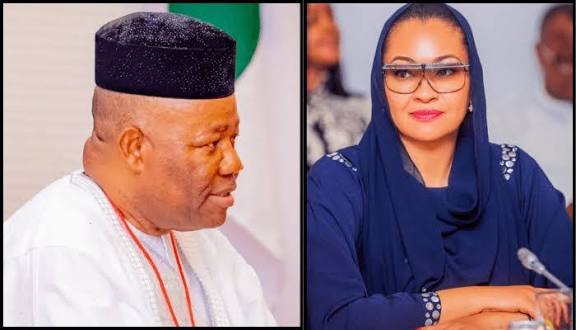
Senator Natasha visited the office of Senator Titus Zam, Chairman of the Senate Committee on the North Central Development Commission (NCDC), to question why she was not included as a member of the committee.
By Senate convention, only two senators from each state may serve on a particular committee. In this case, Kogi State’s two available slots were already occupied – one senator serving as Vice Chairman, the other as a member.
“It’s arithmetic embedded in rules,” a senior legislative officer said. “The two-slot provision prevents dominance by any one state delegation.”
According to multiple sources familiar with the meeting, Senator Natasha arrived at Zam’s office accompanied by aides who immediately began recording video upon entry.
“That changed the atmosphere,” one lawmaker familiar with the exchange said. “Recording from the outset signals confrontation rather than quiet negotiation.”
An aide in Zam’s office reportedly objected, asking, “Must everything be on social media?” What followed was a rapid escalation. During attempts to stop the recording, one aide was allegedly slapped, leading to what insiders described as “an exchange of slaps” between aides on both sides.
“The senators themselves did not physically engage,” one principal officer clarified. “But when aides begin exchanging blows inside a committee chairman’s office, it becomes an institutional matter.”
Professor Ayo Olukotun, a political communication scholar, argues that such confrontations carry reputational consequences beyond the immediate participants.
“In elite institutions, repeated confrontation shapes narrative,” Olukotun said. “Politics is built on relational capital. When episodes accumulate, perception crystallises.”
Within the National Assembly of Nigeria, committee assignments are not ceremonial placements; they are power structures. They determine oversight reach, budgetary leverage, and policy visibility.
Dr. Rotimi Suberu, professor of political science, describes committee membership as “distributed authority.”
“Committees are where legislative muscle is exercised,” Suberu explained. “Exclusion from a committee can be perceived as marginalisation because influence is channelled through these structures.”
Yet colleagues privately insist that in this case, the exclusion was procedural rather than personal. “The rule is clear,” one senior senator said. “Two senators per state. Once those slots are filled, that is it.”
Still, perception often outweighs technicality in political environments. Dr. Suberu calls this tension “institutional friction under structural constraint.”
“When ambition meets procedural limitation, frustration can surface,” he noted. “How that frustration is expressed determines future alliances.”
The dual episodes – the seat-tagging during Finance Committee budget defence and the office confrontation over NCDC membership – have prompted colleagues to assess their broader implications.
On one level, assertiveness can enhance political capital among constituents.
Sam Amadi, a governance analyst and former regulator, notes that visible resistance to perceived marginalisation can energise grassroots support.
“In electoral politics, confrontation can be reframed as courage,” Amadi said. “Supporters often reward leaders who appear unwilling to be sidelined.”
Indeed, among segments of her political base, the incidents have been interpreted as evidence of tenacity – a refusal to accept diminished influence.
However, legislative politics functions on different incentives. “Intra-parliamentary influence depends on trust and predictability,” Professor Jinadu cautioned. “Colleagues must feel comfortable negotiating behind closed doors.”
A ranking senator offered a candid assessment: “No senator passes complex legislation alone. You need quiet cooperation. If colleagues anticipate volatility, they may limit engagement.”
Gender dynamics further complicate interpretation. Professor Abiola Akiyode-Afolabi, a legal scholar and gender governance expert, argues that women legislators face narrower margins of acceptable behaviour.
“In male-dominated institutions, assertiveness from women is often judged more harshly,” she observed. “There is a double bind: too quiet and you are invisible; too forceful and you are labelled disruptive.”
Another gender analyst, Dr. Ayisha Osori, emphasises the structural nature of such tension.
“Women in politics constantly negotiate legitimacy,” Osori said. “Institutional pushback can be interpreted as resistance to female authority, but strategic calibration remains essential.”
Inside the Senate, however, colleagues tend to speak less about gender and more about pattern. “One incident is manageable,” a second-term senator said. “Two in close succession create concern about trajectory.”
The Senate’s culture is deeply hierarchical. Seniority, party alignment, and committee negotiation are choreographed carefully. Informal networks often determine formal outcomes.
“Institutional memory matters,” one principal officer noted. “If you build a reputation for unpredictability, invitations to critical discussions may reduce.”
Yet others caution against overreading. “Politics is dynamic,” a former presiding officer observed privately. “Moments of friction are common. What matters is whether they become defining identity.”
Professor Ibrahim situates the situation within broader democratic stress. “Nigeria’s political institutions are under constant strain,” he said. “Conflict within them reflects wider democratic contestation.”
For Senator Natasha, the path forward contains both risk and opportunity. Positively, a reputation for assertiveness can consolidate her image as an uncompromising advocate. It may strengthen her appeal among voters who interpret institutional friction as evidence of systemic resistance to reformist voices.
Negatively, sustained confrontation may narrow her manoeuvring space within committee structures – the very arenas where legislative influence is concentrated.
“There is a delicate calibration between protest politics and institutional politics,” Dr. Suberu said. “Successful lawmakers learn to operate in both registers.”
A senior senator offered a succinct summary: “Electoral strength is external power. Committee influence is internal power. Balancing both determines longevity.”
For now, Senate leadership has not announced disciplinary measures linked to the recent episodes. The matters remain internally discussed rather than formally escalated.
“Leadership is watching,” one insider disclosed. “Nobody wants escalation, but nobody ignores pattern.”
Within the Senate chamber, where alliances are fluid and memory is long, perception can harden quickly.
As Professor Olukotun concluded: “Institutions interpret behaviour collectively. When actions cluster, they acquire narrative weight.”
Whether the past two weeks represent a temporary surge of frustration, strategic recalibration, or deeper institutional strain remains uncertain.
But in the quiet corridors of the Red Chamber, where silence often carries more meaning than speech, colleagues are paying close attention – not merely to what has occurred, but to what comes next.
Because in legislative politics, space is negotiated, influence is accumulated slowly, and reputation – once formed – can shape an entire career.