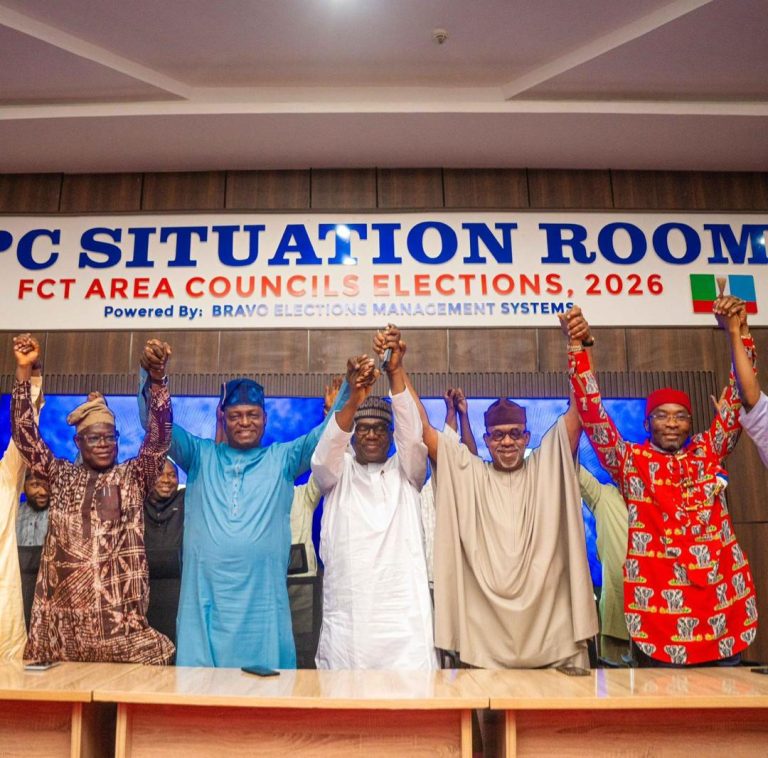
Five of the six Area Councils in the nation’s capital were won by the ruling All Progressives Congress (APC), strengthening its hold on the Federal Capital Territory (FCT) ahead of the general election in 2027.
Yesterday, President Bola Tinubu praised the successful holding of the FCT polls on Saturday and the by-elections in the states of Rivers and Kano, claiming that the elections have further solidified the nation’s democratic institutions and culture.
The party’s successes in the Federal Capital Territory and the by-elections in Kano and Rivers states, according to APC National Chairman Professor Nentawe Yilwatda, are a resounding evidence to the party’s tenacity, cohesion, and grassroots power.
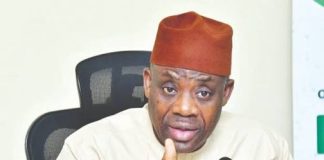
Nyesom Wike, the FCT Minister, praised Tinubu for successfully conducting Saturday’s FCT area council elections, claiming that the results have exposed emergency Democrats who have chosen to see nothing positive in the nation and its leadership.
The Southern Governors’ Forum, led by Ogun State Governor Dapo Abiodun, praised the APC’s performance, stating that it reflects the broad popularity of the party among Nigerians.
The results of the poll, according to the APC’s Lagos State branch, are a positive testament to Tinubu’s achievements.
But the PDP demanded that the Independent National Electoral Commission (INEC) make the results of two Kuje Area Council wards available right now. According to PDP, there were signs that it was leading both councils.
Additionally, the party praised its FCT election winners.
In a similar vein, PDP presidential candidate Dr. Gbenga Hashim said the results of the FCT polls were clear proof that the party was regaining ground before the general election in 2027, even in the face of political pressure and internal difficulties.
As of yesterday, there was no formal response from the national leadership of the African Democratic Congress (ADC), the opposition coalition party, on Saturday’s elections.
Citing evidence of voting irregularities, Dr. Moses Paul, the ADC’s candidate for chairmanship of the Abuja Municipal Area Council (AMAC), refused to accept loss and vowed to keep fighting for the mandate of the people.
In the FCT elections, however, INEC refused to allow voters to move to voting places that were different from their original locations. Additionally, the Economic and Financial Crimes Commission (EFCC) reported that 20 people were arrested for alleged various electoral offenses during the FCT elections.
The APC won Abuja Municipal Area Council (AMAC), Kwali, Kuje, Bwari, and Abaji in the Saturday, February 21 FCT Area Council elections, while the PDP took Gwagwalada.
On Sunday morning, INEC announced that Mohammed Kasim of the PDP had won the poll to be the chairman of the Gwagwalada Area Council.
Mohammed won a landslide victory in a fiercely contested election with 22,165 votes, according to INEC Returning Officer Philip Akpen. APC candidate Yahaya Shehu came in second with 17,788 votes.
Mohammed satisfied the legal conditions to be reinstated as the legitimately elected chairman, Akpen said.
Even though the stakes were high, he called the election process “peaceful and smooth.”
The Kwali Area Council chairperson election was likewise declared won by Daniel Nuhu of the APC by the electoral umpire. Haruna Pai of the PDP received 8,575 votes to finish second in the election, but Nuhu received 17,032 votes to defeat her.
INEC proclaimed APC candidate Joshua Ishaku the victor of the election for chairman of the Bwari Area Council.
When announcing the results, returning officer Mohammed Nurudeen stated that Ishaku had received 18,466 votes in total to win the election.
The commission proclaimed APC candidate Zakka Christopher the victor of the AMAC chairmanship contest.
The ADC received 12,109 votes, while the APC candidate received 40,295 votes, with the PDP trailing with 3,398 votes.
The winning streak of the ruling party was extended after INEC announced Hon. The APC’s Abdullahi Abubakar was elected to the Abaji Area Council. In all, Abubakar received 15,535 votes.
The Young Progressives Party (YPP) candidate, who received 5,357 votes, was his nearest opponent. After receiving 4,547 votes, the PDP candidate was trailed by the New Nigeria Peoples Party (NNPP) with 53 votes and the ADC with 37 votes.
INEC also announced that Hon. The Kuje Area Council election was won by APC candidate Samuel Shekwolo.
Before the general election in 2027, it is thought that Tinubu and the APC had strengthened their hold on Abuja as a result of the results of the FCT area council election.
Despite being an off-season exercise, the FCT election might not be used as a benchmark.
Tinubu: The FCT, Rivers, and Kano polls were successfully conducted, strengthening democracy.
President Bola Tinubu emphasized that democratic institutions and culture have been further reinforced by the successful holding of Saturday’s elections in the Federal Capital Territory, Rivers, and Kano.
In order to provide even more excellent electoral procedures, Tinubu urged INEC to keep up its good work.
The president congratulated the winners in the Federal Capital Territory, Rivers, and Kano states in a statement issued by his adviser on information and strategy, Bayo Onanuga.
Tinubu called on the victors to serve with humility, patriotism, and commitment, and to treat the people’s mandate as a sacred trust.
Wike’s accomplishments in the FCT, which had benefited the ruling APC politically, were praised by him.
The president congratulated the APC’s national leadership, Kano and Rivers leaderships, and all party members on their electoral successes.
For the successful and peaceful election process, he praised INEC, security forces, and voters.
He added that democracy is enhanced by the vitality of competition and participation, and he praised the bravery and self-control shown by each candidate.
Yilwatda: APC Wins Are a Manifest Sign of the Power of the People
APC National Chairman Professor Nentawe Yilwatda said the party’s wins in the FCT and the by-elections in Kano and Rivers states were a tribute to the party’s tenacity, cohesion, and grassroots power.
In a post on X, Yilwatda praised the discipline and commitment of party officials, party members, and supporters in the two states and the Federal Capital Territory.
“I congratulate our throngs of All Progressives Congress (APC) supporters in the Federal Capital Territory, Kano, and Rivers States on the successful and peaceful hold of the polls on Saturday, February 21, 2026,” he said.
“The documented successes are a resounding monument to our great party’s tenacity, solidarity, and grassroots power.
The PDP chairmanship candidate who won in Gwagwalada and the five APC chairmanship candidates who won in AMAC—Kuje, Abaji, Bwari, and Kwali—have my sincere congratulations.
“Democracy has triumphed because the people have spoken through the ballot.” I also extend my congratulations to the four candidates for the state House of Assembly who won in the states of Kano and Rivers.
Wike: Emergency Democrats Are Outcome-Exposed by FCT Poll Results
In addition to congratulating President Bola Tinubu on the peaceful conduct of the FCT elections, FCT Minister Nyesom Wike said that the results have revealed emergency democrats, who see nothing positive in the nation and its leadership.
“The election results have demonstrated to Nigerians which party is the ruling party and which is the true opposition party in the country,” Wike stated in a broadcast yesterday.
He characterized the election’s calm conduct as evidence of the FCT’s citizens’ dedication to democracy and responsible government.
“The people of FCT showed that they are not fooled by emergency Democrats, who have decided not to see any positive aspects of our nation and its government,” Wike stated.
For the achievements he had brought to FCT, he thanked the president.
The minister claimed that Tinubu’s vision and leadership were evident in the election, which also demonstrated how the Renewed Hope Agenda had given the people of FCT hope and confidence.
In fact, this election has demonstrated that Nigerians are now aware of the true opposition party and the ruling party,” he said.
“The election has also brought to light the hypocrisy of those who purchase corn and groundnuts from street vendors for campaign purposes in an attempt to mislead Nigerians.”
Residents of the Federal Capital Territory showed yesterday that emergency Democrats, who have decided to perceive nothing positive in our nation and its government, cannot fool them.
“I am appreciative of the progress that Mr. President has made in the FCT. The president’s vision and leadership are evident in this election, which also serves as evidence that the FCT’s citizens now have hope and confidence thanks to the Renewed Hope Agenda.
President Bola Ahmed Tinubu’s dedication to enhancing the quality of life for Nigerians, especially those living in the Federal Capital Territory, has undoubtedly not gone unnoticed.
“Under his leadership, we are certain that the FCT will continue to be a model of development and progress, and the Renewed Hope Agenda has given us hope for a better future.”
“I applaud the president for his unwavering support of democracy, especially in securing the Electoral Act’s amendment to improve the conduct of credible elections,” Wike continued. This shows his dedication to enhancing our democratic system.
“At this point, I also want to congratulate the Independent National Electoral Commission (INEC) on holding an election that was credible, free, and fair. President Tinubu’s dedication to bolstering our democratic institutions and guaranteeing the integrity and transparency of our electoral procedures is reflected in this.
South Governors’ Forum Applauds Tinubu and the APC
Under the direction of Ogun State Governor Dapo Abiodun, the Southern Governors’ Forum praised the APC’s success in the area council elections, claiming that the party’s impressive turnout reflects Nigerians’ broad support for it.
Abiodun said in a statement in Abeokuta that the APC’s impressive showing was a support for Tinubu’s Renewed Hope Agenda.
In addition to congratulating the APC chairman and president, Professor Nentawe Yilwatda, and the party’s candidates on their outstanding success, Abiodun said the party’s showing at the polls was a sign that it would win the general election in 2027.
The results of the FCT’s area council elections undoubtedly demonstrated that Nigerians are completely in support of President Bola Tinubu and the APC, and they will do so once more in the general election in 2027, the governor said.
The great majority of Nigerians are aware that the APC is in charge and that their country’s future is secure. I commend President Bola Tinubu and our wonderful party, the APC, for this outstanding performance, which is a sign of our 2027 victory.
APC in Lagos: A Referendum on Tinubu’s Legacy
The APC’s Lagos State Chapter stated that the outcomes of Saturday’s elections in Rivers, Kano, and the Federal Capital Territory were evidence of President Bola Tinubu’s accomplishments.
The results, according to a statement from the party’s spokesperson Seye Oladejo, were a “deep gratitude to the good people of Rivers and Kano States, the Federal Capital Territory (FCT), and Nigerians at large for their overwhelming support for our great party and the president in the just concluded by-elections.”
The results of the by-elections in all impacted areas, according to Oladejo, constitute an unmistakable and transparent referendum on Tinubu’s leadership and the progressive principles that still lead the nation’s government.
Oladejo said, “The overwhelming wins our candidates achieved confirm the electorate’s faith in the Renewed Hope Agenda and the revolutionary reforms being carried out at the federal and state levels.
“The electorate has made a clear decision through voting at a time when critics and opposition forces have attempted to distort the nation’s course.
These findings show that when Nigerians witness strong institutional development, economic reforms, infrastructure growth, and fearless leadership, they recognize it.
ADC Candidate Promises to Keep Fighting for AMAC’s Future
Regardless of the voting results, Dr. Moses Paul, the ADC chairman candidate for Abuja Municipal Area Council (AMAC), promised to keep fighting for the people’s mandate. He said that the INEC-announced results included poll fraud.
“Today, I stand before you as a man enlarged by a movement, not a man diminished by an outcome,” Paul said.
“A movement born not of convenience, but of conviction,” he continued. a movement led by people rather than by authority. A movement that was written in sacrifice rather than ink.
Paul commended the AMAC community for their bravery and tenacity, stating, “You rose.” You were up. You went for a walk. You talked. You had that belief. I bow my head in thanks for it.
The fight for a better AMAC would go on, he emphasized.
“An idea whose time has come has never been defeated by any force in history,” he declared.
In addition to thanking volunteers, supporters, and the people of AMAC, the ADC candidate promised to continue to be dedicated to their cause.
“I am still accountable to you,” he said. I am still one of you. Our trip is far from over. A permanent awakening is about to occur.
In the Kano Assembly By-elections, the APC wins.
In the Kano State by-election held on Saturday, the APC emerged victorious in both the Kano Municipal and Ungogo local government districts.
In the elections to replace the parliamentary vacancies in the Kano Municipal and Ungogo constituencies, respectively, INEC proclaimed Nabil Aliyu Daneji and Aminu Sa’ad Sa’ad, the APC candidates, the winners.
Daneji defeated eight other candidates with 7,484 votes, according to Kano Municipal Returning Officer Professor Ibrahim Tajo Siraj.
Following the compilation of results from the impacted polling stations, the announcement was made, reaffirming the APC’s victory in the election.
Professor Ali Tijjani Abdullahi, the Returning Officer, proclaimed Sa’ad the victor in the Ungogo constituency after he received 8,975 votes, more than any other candidate.
Acknowledging the collaboration of political parties, observers, and voters, Abdullahi confirmed that the result represented the will of the people.
But according to the Kwankwasiyya movement, Rabiu Kwankwaso, the national leader of the New Nigeria Peoples Party (NNPP), was the one who first proposed the two APC candidates in the Kano State by-elections.
According to a statement from the group’s spokesperson, Habibu Sale Mohammed, Kwankwaso nominated the two candidates’ sons prior to their joining the APC.
He said Kwankwaso’s choice to nominate the lawmakers’ sons was an homage to their fathers, who died that same day when they were represented by the NNPP in the state House of Assembly.
The announcement read, “National Leader Rabiu Musa Kwankwaso supported the nomination of their children as party flag bearers as a gesture of compassion and remembrance.” This choice was made in appreciation of the MPs’ dedication to the party and their sacrifices.
The PDP applauds all of the successful candidates and requests that INEC release the Kuje results.
In the Kuje Area Council, the PDP leadership demanded that INEC make the results of the two ward elections public.
Due of its slim leads in the two wards, the party sparked concerns about manipulation.
In a statement, PDP National Publicity Secretary Ini Ememobong expressed the party’s concern that INEC has not yet released the results from two wards in Kuje Area Council.
The slight advantage the Peoples Democratic Party holds there, which we know is vulnerable to manipulation by security agents, has caused concern over this delay.
We urge the INEC chairman to promptly order the results in Kabi Wards and Kuje Central to be announced, as the majority of them have already been placed on the IREV.
“The outcome of an election must accurately represent the people’s votes; otherwise, the entire process is deemed invalid.” We must protect the ballot’s sanctity.
The PDP congratulated the candidates who won the FCT election.
The party said in another statement by Emeombong, “This victory is especially heartening because it comes against a backdrop of unprecedented intimidation, powerful money politics, and blatant executive brigandage, even though it was smaller than we expected.”
Armed security guards were allegedly employed to harass voters, carry away result sheets from polling places, and improperly sway the election’s results, according to several reports and video evidence.
In particular, we extend our congratulations to Mohammed Kasim, the Gwagwalada Area Council’s chairman-elect, and the council members who have been deemed successful by the Independent National Electoral Commission (INEC).
“We have assembled a special legal team, led by National Legal Adviser Shafi Bara’u, Esq., to assist with post-election litigation and to address candidates with legitimate grievances resulting from these elections.
“They should get in touch with the National Legal Adviser right away for swift action, since in election petition cases, delay is fatal.”
According to Emeombong, the anti-people Electoral legislation 2026 caused the public to lose faith in the results of elections held under the legislation, which is why there was a noticeable lack of enthusiasm among voters in the polls.
FCT Results Indicate PDP’s Comeback Ahead of 2027 Elections, Says Olawepo-Hashim
The results of the FCT polls, according to PDP presidential candidate Gbenga Olawepo-Hashim, were compelling proof that the party was regaining ground ahead of the general election in 2027, despite internal difficulties and political pressure.
In response to the findings, Olawepo-Hashim praised party members and supporters for what he called a “outstanding performance under difficult circumstances,” stating that the polls show that the PDP is still structurally sound and strong enough to win elections in spite of internal issues.
The PDP, he declared, is a revived party. Despite national leadership disagreements and intentional attempts to undermine our FCT organization, the masses remained loyal to the party.
“You cannot suppress structure,” he declared, praising ward leaders, polling unit agents, and party followers in particular for their “unshakable loyalty to the party logo.” Confidence cannot be intimidated. The voice of the grassroots has been heard.
Gwagwalada is praised by the CP-PDP, which also claims that the PDP won Kuje and two other seats.
The Gwagwalada Area Council Chairman-elect, Mohammed Kasim, and the other council members were congratulated by the Conference of Professionals in the Peoples Democratic Party (CP-PDP) on winning the FCT council elections.
Obinna Nwachukwu, the chairman of the CP-PDP, was warned about the APC’s purported plot to terrorize the populace, instigate unrest, and deny the PDP its victory in Kuje by using compromised security forces.
The conference claimed to have video proof of the heavy security forces’ firing, intimidating, and stealing of ballot boxes while the results from the most popular wards, Kuje Central and Kabi, were being manipulated for the APC.
The CP-PDP called on the Inspector General of Police to step in and make sure that only the results that accurately represented the votes cast were revealed, describing the situation in Kuje as a recipe for a major crisis in the FCT.
“The PDP’s performance and popularity in the FCT election, in spite of the APC’s repeated attacks, threats, intimidation, propaganda, lies, and extensive shenanigans using the FCT Minister, Chief Nyesom Wike, further underscore the undisputed strength and potency of the PDP at the grassroots level across the country,” the CP-PDP said.
INEC Prohibits Voters from Moving to Different Polling Places During the FCT Council Elections
Voters who migrated to polling places other than their original ones during the FCT elections were denied access by INEC.
Wilfred Ifogah, Acting Director of INEC Voter Education and Publicity (VEP), said in a statement that the commission created split voting units at major polling places with more than 1,250 registered voters in order to prevent traffic on election day.
Ifogah said, “The commission did observe that some voters had trouble finding their assigned polling places.
In contrast to the assertion made in certain quarters that some voters were moved to new or different polling places from their original ones, the commission would like to make it clear that no voters were moved. Instead, it created split polling places in sizable polling places with more than 1,250 registered voters in order to prevent traffic on election day.
“Within the same premises, the split units are situated a few meters from the original polling stations.”
“The public will remember that four days prior to the Area Council elections, the commission displayed the register of voters at designated centers/split polling units to enable voters to confirm their details and polling unit locations,” Ifogah continued.
He said that on February 18, 19, 20, and 21, the impacted voters received emails and texts with the precise locations of their split polling places. He claimed that the notifications were only meant to serve as a reminder to help voters locate the voting places they are currently in.
According to Ifogah, the commission’s Election Operations Dashboard shows that all polling places were verified to be open by 10 a.m. on election day, with 45% of them opening for voting at 8:30 a.m.
Electoral Fraud: EFCC Arrests 20
Twenty people were reportedly arrested by EFCC agents yesterday on suspicion of committing various electoral offenses during the FCT elections.
In a statement released by its Head of Media and Publicity, Mr. Dele Oyewale, the anti-graft agency said that the offenders had been taken into custody by local government councils within the Federal Capital Territory.
The suspects were detained around the Federal Capital Territory (FCT) for offenses including vote buying, vote selling, and officer obstruction, totaling N17,218,700 (seventeen million, two hundred and eighteen thousand, seven hundred Naira only), according to the statement.
In the Kwali local government area, one of the suspects was apprehended in a car parked next to a polling station with N13,500,000 (Thirteen Million, Five Hundred Thousand Naira).
Four of the individuals were apprehended in the Kuje and Kwali council areas, nine were apprehended in Gwagwalada, and two were apprehended in Abaji, according to Oyewale’s breakdown of the numbers.
He went on to say that after the inquiry was finished, all of the people who had been arrested will face charges.
OTHER LEAD
Senate Leader: Before Tinubu’s “swift” assent, the Electoral Act was shaped by CSOs, AGF, and INEC
* Cites 24-hour presidential approval as justification for two-year consultation
*Asserts that the legislature’s new law is the result of collective input rather than its own initiative.
*To preserve democracy, Catholic Bishops Order NASS to Reexamine Position on Electoral Act
*Akume claims that no human law is flawless.
Abuja’s Onyebuchi Ezigbo and Sunday Aborisade
According to Senate Leader Opeyemi Bamidele, the “swift” presidential assent to the Electoral Act, 2026 was justified because it was the result of two years of intensive engagement with important stakeholders.
Civil society organizations (CSOs), the Office of the Attorney-General of the Federation (OAGF), the Independent National Electoral Commission (INEC), and development partners were among the stakeholders, according to Bamidele.
Concerns were raised in some sectors regarding President Bola Tinubu’s hasty signing of the measure into law, which occurred only 24 hours after the National Assembly submitted it.
The senate leader maintained in a statement issued by his Directorate of Media and Public Affairs that the president’s quick assent did not signify a hurried endorsement but rather demonstrated the breadth of earlier discussions that influenced the legislation long before it was finally passed.
“Almost all important stakeholders participated in the creation of the Electoral Act, 2026,” Bamidele said. He emphasized that the National Assembly’s actions were not isolated.
“The National Assembly worked with a variety of stakeholders, including OAGF, CSOs, INEC, and our development partners, among others, before we finally finished the process,” Bamidele stated.
“As we advanced, the stakeholders also provided feedback, and the Act incorporated all of their suggestions.”
He said there was no need for a lengthy executive review because of the thorough consultation and the time restrictions ahead of the 2027 general election preparations.
“Given the current time constraints, I don’t think the executive needs days or weeks to review it before assent since we all contributed to it,” Bamidele said. Nigerians as a whole, not just the parliament, are responsible for its success.
Before sending the final version to the president, the National Assembly had already standardized various versions of the Electoral Bill 2026 that had been approved by both houses, especially Clause 60(3), in order to prevent any administrative or constitutional issues in the run-up to the next general election.
The new electoral governance framework, which included extensive reforms intended to improve accountability, increase transparency, and strengthen institutional independence in Nigeria’s election management system, went into effect with Tinubu’s approval.
Section 3 of the act established a specific fund for INEC, which was one of the main provisions.
The step, according to Bamidele, ensured the commission’s administrative continuity, operational stability, and financial independence.
In order to avoid last-minute financial bottlenecks, the law mandated that election money be released at least six months before to a general election.
INEC was also given the authority to examine dubious results declarations made under pressure or against established protocols.
The act also required election results to be transmitted electronically.
In accordance with Section 60(3), INEC’s Result Viewing Portal (IReV) must receive polling unit results electronically. According to the act, any presiding officer who willfully obstructs this procedure faces a fine of N500,000, six months in jail, or both.
IReV improved transparency by making polling unit results available to the public, but Bamidele made it clear that it was not a platform for collation.
He also mentioned that in cases where electronic transmission was unsuccessful due to communication difficulties, the law offered a conditional fallback to manual transmission using Form EC8A.
Furthermore, Section 47 requires that the Bimodal Voter Accreditation System (BVAS) or any other technology that INEC specifies be used for voter accreditation.
Presiding officers had to confirm and authenticate the information provided by prospective voters in accordance with the commission’s guidelines.
The law established more stringent accountability measures in addition to technology. Within 24 hours of receiving payment, a Resident Electoral Commissioner (REC) is required by Section 74(1) to provide certified true copies of the requested electoral documents. Noncompliance carries a minimum sentence of two years in prison without the possibility of a fine.
In addition, Section 72(2) stated that in the event that INEC was unable, unwilling, or neglected to issue a certificate of return, a certified true copy of a court order announcing a winner would be adequate for swearing-in.
Indirect primaries were eliminated by the act, and Section 84(1-2) restricted parties to direct and consensus choices.
According to lawmakers, the goal of the change was to increase party member participation and reduce the amount of money that delegate-based elections generate.
Political parties were required by Section 77 to maintain digital membership registers, provide membership cards, and submit the register to INEC at least 21 days prior to primaries, congresses, or conventions in order to bolster internal democracy.
If a party didn’t follow the rules, they couldn’t run candidates in the election.
The law also strengthened penalties for electoral offenses like vote buying, impersonation, and result manipulation, imposing jail sentences or fines upon conviction, and increased campaign spending caps to reflect current economic realities.
Compliance and inclusivity were encouraged by other clauses.
For example, Section 49 permitted gender-sensitive queue arrangements when cultural norms demanded it; Section 54 created mechanisms for people with visual impairments to receive support; and Section 93(4) fined any political party that did not submit accurate audited returns within the allotted time.
The Electoral Act, 2026, Bamidele insisted, was a consolidation and improvement of Nigeria’s electoral system, despite persistent skepticism in some civil society circles.
“The Act aims to improve electoral credibility, decrease disputes, and strengthen democratic governance in Nigeria,” he stated.
Its quick assent, he reaffirmed, was the result of long, inclusive, and thoughtful legislative work rather than an act of mercy.
Examine the Electoral Act Position to Preserve Democracy, Catholic Bishops Inform NASS
In order to represent the will of Nigerians and protect the nation’s democracy from preventable threats, Catholic bishops in Nigeria, acting through the Catholic Bishops Conference of Nigeria (CBCN), requested that the federal government and members of the National Assembly immediately review the Electoral Act.
The federal government, however, filed a lawsuit asking for tolerance and understanding regarding the problems caused by the amended Electoral Act, claiming that any flaws in the legislation would be fixed eventually.
Speaking at the CBCN’s First Plenary session in Abuja, Most Rev. Lucius Iwejuru Ugorji, the Archbishop of Owerri and the organization’s president, urged the National Assembly to immediately examine the amended Electoral Act in relation to the electronic transmission of election results so that it reflects the desires of the vast majority of Nigerians.
Prior to the general election in 2027, he said, the Catholic Bishops’ call for a review of the electoral law had become essential in order to protect the nation’s democracy from preventable threats.
According to Ugorji, “The National Assembly (NASS) should review its recent stance on electoral reform and work to restore Nigerians’ trust by making sure that the Electoral Act requires the mandatory transmission of election results in real-time from the Bimodal Voter Accreditation System (BVAS) at the polling station to the INEC Result Viewing (IReV) portal at the commission’s headquarters to prevent any human tampering with the expressed will of the electorate going forward.”
“We must respect the people’s will, which is this. This will help ensure that our country’s general elections are free, fair, and credible. By approving a bill that weakens the will of the people and makes it possible to rig election outcomes.
The National Assembly was reminded by the president of CBCN that it had already approved the 2025 Tax Bill, which required digital filing, record-keeping, and payments nationwide.
Ugorji, who was nearing the conclusion of his term as head of the Bishops Conference, stated that lawmakers shouldn’t let themselves be seen as taking conflicting and inconsistent stances while passing legislation.
Regarding insecurity, Ugorji stated that the nation has persistently faced growing security issues, and that Nigerians are still subjected to heartbreaking stories of needless killings, mass funerals, and unending sorrow.
Additionally, he stated that illegal mining connected to banditry operations and their foreign allies continued to cost the nation roughly $9 billion a year.
“The recent wave of mass kidnapping incidents by gunmen in Kwara, Kebbi, Niger, Kaduna, and Kogi States, involving many students, pupils, and worshippers, has heightened tensions in the country,” he stated.
According to Ugorji, CBCN insisted that the federal government take decisive action to apprehend and prosecute terrorists, bandits, and those who support them.
However, according to the federal administration, significant efforts were made on all fronts to try to address the issues the nation faces.
Senator George Akume, the Secretary to the Government of the Federation (SGF), told the CBCN plenary that the nation was gradually overcoming the many obstacles it faced.
Akume stated that the decrease in food costs was one of these areas where notable progress had been accomplished. He also mentioned that many impoverished students were receiving loans to complete their education as a result of government actions.
Akume addressed the worries raised by the newly signed modified Electoral Act by stating that no human law was flawless and that the Bill had undergone appropriate process before being passed.
Those who are unhappy with the modified Electoral Act should exercise patience, he said, adding that any flaws will be fixed eventually.
Regarding insecurity, Akume stated that a lot was being done to address the issue, which he claimed was not unique to Nigeria.
Foreigners were responsible for the majority of the banditry and terrorism acts in several regions of the country, Akume clarified.
He said, “I want to look at the matter holistically. Many of these arrested individuals, I should mention, do not speak English. Their Hausa is pretty weak, but they can speak French. In Nigeria, do we speak French?“
Earlier in his sermon, Archbishop Ignatius Kaigama, the Catholic Archbishop of Abuja, emphasized the importance of respect for one another and dedication to the common good.
Although Kaigama claimed that food prices were gradually declining in the nation, he was concerned that fuel and transportation expenses had remained high, making life tough for Nigerians.
“Lent and Ramadan coming together is a reminder of our common beginning and end,” he said. It calls for a stronger commitment to the common good and better respect for one another as opposed to conflict, violence, and the pursuit of numerical superiority.
Regarding the electoral law, Kaigama said the government should make sure that the results of the general election in 2027 are transmitted electronically.
Speaking on the subject of “Power of Leadership,” the event’s chairman, Mr. Mike Omeri, stated that a good leader must possess humility, courage, and purpose.
According to him, “we need leaders who will seek the common good of Nigerians and bridge the gap between the rich and the poor.”