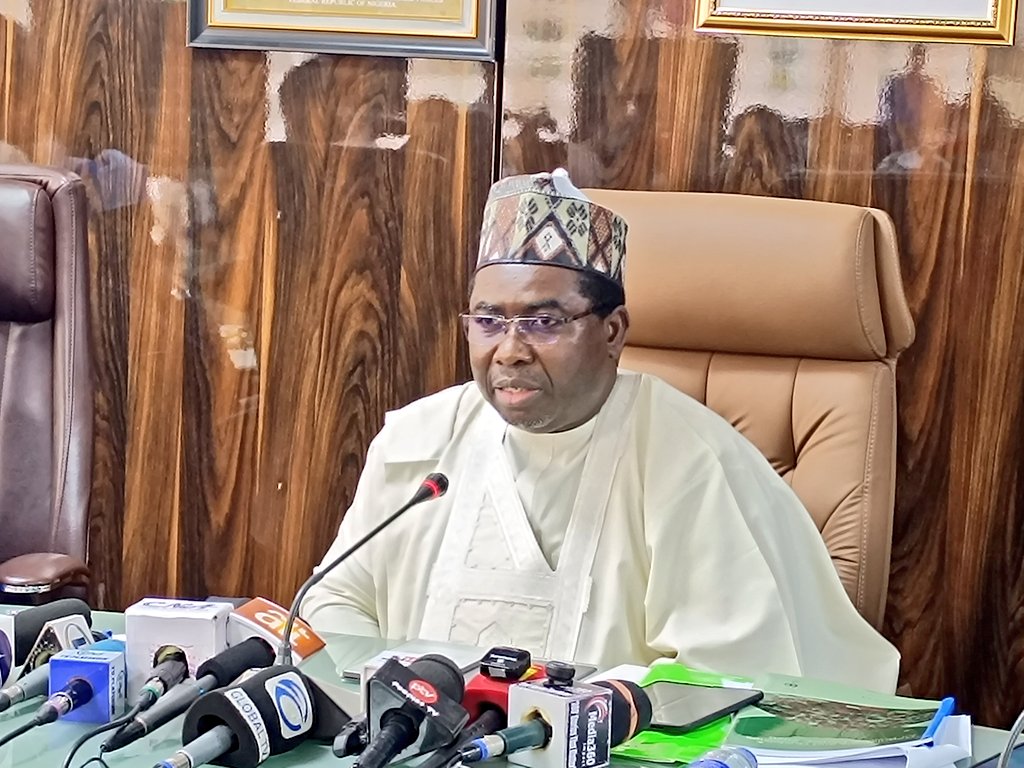
Prof. Joash Amupitan, the chairman of the Independent National Electoral Commission (INEC), announced a thorough review of the Commission’s rules and guidelines for political parties. He described the action as a crucial step in bolstering Nigeria’s democratic process in advance of the 2027 general election.
Amupitan stated that the updated standards are intended to comply with the Electoral Act 2026 and address systemic issues affecting party operations and electoral credibility at a consultative meeting with political party leaders at INEC headquarters in Abuja on Tuesday.
The INEC chairman underlined the significance of openness in candidate selection procedures, emphasizing that legitimate elections start well in advance of election day.
“We cannot navigate a 2027 horizon using a 2022 map,” he continued, adding that the revised framework was created in accordance with the new electoral law and constitutional rules.
The presidential and National Assembly elections are scheduled for January 16, 2027, while the governorship and state assembly elections will take place on February 6, 2027, according to Amupitan, highlighting the tight electoral timeline that stakeholders must deal with.
He claims that INEC and political parties must plan and carry out the shortened timescales brought about by the Electoral Act 2026 with what he called “surgical precision.”
Important facets of political party administration, such as registration and mergers, internal operations, primaries, campaign behavior, financing, and deregistration procedures, are covered by the updated standards.
According to Amupitan, one of the main causes of voter disinterest and post-election litigation is opaque procedures in party primaries, which are intended to be eliminated by the reforms.
Additionally, the new framework establishes more precise guidelines for campaign activities, guaranteeing that processions and demonstrations are carried out peacefully and in accordance with the rights of citizens.
The INEC chairman cited sections of the Electoral Act 2026 that give the Commission the authority to set election expenditure caps after consulting political parties.
He emphasized that transparency in finance is crucial for fair elections and asked party leaders to pay special attention to provisions pertaining to election expenses, especially those controlling party primaries and campaign financing.
Amupitan said that empirical results from the Political Party Performance Index (PPPI), a diagnostic instrument created with assistance from the Westminster Foundation for Democracy, served as the basis for the review process.
According to him, the score highlighted the need for reforms to close the gap between party constitutions and grassroots reality.
The INEC chairman declared that the updated guidelines include quantifiable standards for women, young people, and people with disabilities (PWDs) to participate in party activities and elections.
Amupitan advised political parties to see the new rules as protections intended to preserve the integrity of the democratic process rather than as limitations.
He urged interested parties to participate positively in the consultation process, stressing that INEC is steadfastly opposed to the deterioration of democratic ideals while maintaining its commitment to neutrality.
Amupitan reiterated the Commission’s function as an unbiased arbiter and emphasized the necessity of shared accountability in creating an open and reliable electoral system.
“We meet today as joint custodians of Nigeria’s democratic future, not merely as regulators and political actors,” he declared. Amupitan stated that in order to reflect contemporary political and legal realities, the Commission had conducted a thorough technical examination of the 2022 regulations.
“We are safeguarding the Nigerian people’s sovereign will from the nomination process to the final results announcement by tightening these regulations,” he declared.
Dr. Yusuf Mamman Dantalle, National Chairman of the Inter-Party Advisory Council, warned that the current provisions of the Electoral Act 2026 could threaten Nigeria’s democratic process and compromise the legitimacy of the 2027 General Election, and he called for its immediate amendment or outright repeal.
This statement was delivered by Dantalle during a keynote speech at a high-level gathering of political party leaders and the Independent National Electoral Commission (INEC), which took place at the Commission’s Abuja headquarters.
Despite substantial public input during previous public hearings on constitutional and electoral reforms, the IPAC chairman called the Electoral Act 2026 a “significant regression,” pointing out that it fell short of public expectations.
He claims that the bill contains elements that could “impede, weaken, and destabilize” Nigeria’s hard-won democracy rather than bolstering democratic processes.
Dantalle said that the development has put undue pressure on political parties, particularly those outside of government. “It is particularly concerning that this contentious Electoral Act formed the basis upon which INEC released the timetable and schedule for the 2027 General Elections.”
Rejecting the Act’s requirement that political parties have direct primaries is one of IPAC’s main objectives. Dantalle maintained that the process of choosing candidates should continue to be an internal party matter, unaffected by legislative interference.
He emphasized that flexibility in internal party processes is crucial for inclusivity and political stability, and he encouraged the Nigerian National Assembly to immediately review the legislation and reinstate the option of indirect primaries.
The need that political parties submit membership registers, which include members’ National Identification Numbers (NIN), within a strict timeframe of April 1 to April 21, 2026, was also condemned by the IPAC chairman.
He warned that the decision might disenfranchise millions of Nigerians who do not have access to NIN registration services, calling it “impractical and exclusionary.”
“This requirement should be expunged in the spirit of participatory democracy,” he declared.
Dantalle emphasized the importance of fully restoring the electronic transmission of election results, especially via INEC’s IReV platform.
Described as “a fundamental demand of the Nigerian people” and a crucial guarantee for openness, he requested that results be delivered at polling places immediately upon announcement without any precondition measures.
He cautioned against a recurrence of previous mistakes, citing the controversies surrounding the 2023 Nigerian presidential election and stating that similar incidents must not be let to occur again.
The IPAC chief also voiced alarm about the new law’s allegedly laxer sanctions for vote buying, cautioning that the practice is still undermining election credibility.
In order to maintain accountability and discourage wrongdoing, he reiterated recommendations for the creation of an Electoral Offenses Commission.
According to Dantalle, IPAC has called on development partners and the international community to use diplomatic influence to promote Nigeria’s democracy and formally requested the National Assembly to repeal the Electoral Act 2026.
He stated, “The international community is closely observing Nigeria’s democratic trajectory,” and that better results are anticipated in 2027.
INEC was tasked by Dantalle with exhibiting professionalism, technological efficiency, and zero tolerance for operational errors, especially when it came to the implementation of the IReV portal and the Bimodal Voter Accreditation System (BVAS).
“The public’s confidence depends on the assurance that every vote will count, and the Commission’s credibility is at risk,” he said.
Dantalle pledged the Council’s ongoing dedication to promoting political stability, credible elections, and democratic consolidation in Nigeria while reiterating IPAC’s function as the umbrella organization of all registered political parties.
He warned that voter indifference and mistrust will continue in the absence of significant reforms, emphasizing the necessity for leadership based on integrity, accountability, and public confidence.
He stated, “As LP zones the presidential ticket to South, we must collectively sanitize our political environment and uphold standards that inspire public confidence.”
In another development, the Labour Party (LP) claims that the southern region of the nation would host its presidential candidate in the general election of 2027.
Sen. Nenadi Usman, the party’s acting national chairman, made this claim in an interview with reporters on Tuesday in Abuja following the gathering of political party leaders and the Independent National Electoral Commission (INEC).
The INEC Regulations and Guidelines for Political Parties for the 2027 general election were reviewed during the meeting.
Usman stated that although the party’s presidential ticket was available to qualified candidates, a decision had been made to restrict it to southern Nigeria.
We have made one particular choice. Without a doubt, we would not consider any candidates from Northern Nigeria. The role has been allotted to Southern Nigeria, she stated.
Nonetheless, she insisted that the party will respect internal democracy.
“Whoever the public likes and votes for in the primaries will become the candidate when the candidates arrive.”
“It would no longer be democratic to tell you who the candidate will be at this point,” she stated.
In response to inquiries about the planning for the party congresses that are set to begin on Thursday, Usman stated that the congresses would probably be rescheduled in light of the recent spike in party membership.
You are undoubtedly aware that there has been a recent uptick in the number of people wishing to join the LP.
“I believe that many individuals will lose their right to vote if we proceed with adhering to that deadline. Therefore, I don’t think I can give you the precise date or whether it will be changed.
However, I believe we ought to change that date, meet together as a group, and decide on a new one.
Political parties, after course, are about people banding together. Therefore, that decision cannot be made by one individual alone,” she stated.
She praised a recent Yenegua court ruling that rejected a judicial challenge to the party’s leadership on the grounds that it lacked validity.
“Anyone can declare themselves chairman and appear in court, but the court rejected it after finding they lacked locus standi.” “The case has ended,” she declared.
Usman disclosed that a formal suit has been filed with the Nigeria Police Force on the recent assault and vandalism of a party office.
She was certain that the offenders would be held accountable in order to discourage similar acts of political violence in the future.
Usman encouraged Nigerians to use the party’s digital registration portal for party membership.
“I ask that members register using their phones. It’s an online registration procedure.
“Only residents of isolated hamlets or villages without internet access are eligible to register manually in books,” she clarified.
The chairman had earlier praised INEC for providing a briefing on the new Electoral Act of 2026.
She pointed out that the meeting was essential for assisting parties in meeting deadlines for tasks like uploading candidate names and adhering to new rules.