🌿 Ruzu Non-Alcoholic Herbal Bitters
Ruzu Non-Alcoholic Herbal Bitters is a natural health supplement specially formulated to:
- ✅ Promote general wellness
- ✅ Detoxify the body
- ✅ Support the treatment of various ailments
Made from a powerful blend of 100% organic and medicinal herbs, Ruzu is completely alcohol-free, making it ideal for:
- 👪 All age groups
- 🌱 Health-conscious individuals
- 🌿 Anyone seeking non-alcoholic herbal remedies
Whether you're looking to boost your vitality, cleanse your system, or support healing the natural way, Ruzu Bitters offers a trusted herbal solution.
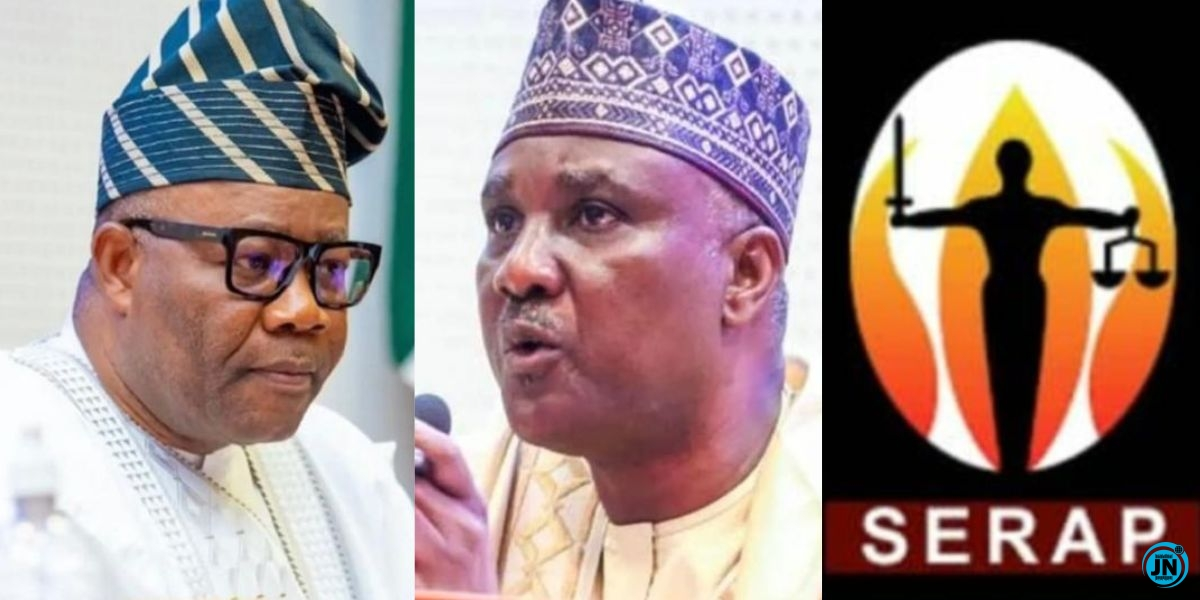
The Socio-Economic Rights and Accountability Project (SERAP) has filed a lawsuit against the Senate President, Mr. Godswill Akpabio, and the Speaker of the House of Representatives, Mr. Tajudeen Abbas, over their failure to account for the missing N18.6 billion meant for the construction of the National Assembly Service Commission (NASC) office complex.
The lawsuit is filed on behalf of all National Assembly members as well as Mr. Akpabio and Mr. Abbas.
The National Assembly Service Commission is a respondent to the lawsuit.
SERAP’s action followed the alarming charges documented in the latest 2022 annual report published by the Auditor-General of the Federation on September 9, 2025.
In the suit number, FHC/ ABJ/CS/2457/2025, filed last week at the Federal High Court, Abuja, SERAP is seeking: “an order of mandamus to direct and compel Mr. Akpabio, Mr. Abbas and the NASC to account for the whereabouts of N18.6 billion meant for the construction of the National Assembly Service Commission Office Complex.
“A mandamus order directing and compelling Mr. Akpabio, Mr. Abbas, and the NASC to reveal the identity of the purported “fictitious construction business” that received N18.6 billion to build the National Assembly Commission Office Complex.”
“An order of mandamus to direct and compel Mr. Akpabio, Mr. Abbas and the NASC to provide the assessment reports, bid advertisements, bid quotations and construction contract, minutes of tender board’s meetings and the Federal Executive Council (FEC) approval for the complex project.
The Nigerian Constitution 1999 [as amended], international anti-corruption norms, and public confidence are all gravely violated by the claims that N18.6 billion intended for the building of the National Assembly Service Commission Office Complex has been misappropriated or diverted.
“Nigerians have a right to know the location of the N18.6 billion and the specifics of the contractors that collected the funds. Legitimate public interests would be served by granting the requested relief.
“Directing and compelling Mr. Akpabio, Mr. Abbas, and the NASC to account for and explain the whereabouts of the N18.6 billion and details of the contractors that collected the money would build trust in democratic institutions and strengthen the rule of law,” claims SERAP.
The suit filed on behalf of SERAP by its lawyers, Kolawole Oluwadare, Kehinde Oyewumi, and Andrew Nwankwo, alos reads in part: “The National Assembly ought to live up to its constitutional responsibilities by upholding and defending the basic principles of transparency, accountability and the rule of law.
“Granting the reliefs sought would also improve public confidence and trust in the ability of the National Assembly to exercise their constitutional and oversight responsibilities, and to adhere to the highest standards of integrity, transparency and accountability in the management of public funds.
The National Assembly Service Commission paid almost N11.6 billion [N11,647,302,594,00] to “an unknown construction company” for “the construction of the commission’s complex within 24 months,” according to the Auditor General of the Federation’s recently released 2022 audited report.
The payment was allegedly paid on August 11, 2020. However, “more than N6.9 billion [N6,930,000.000.00] was added to the contract.” and it is said that on November 29, 2023, the construction company received the funds “for the conversion of the roof garden to office space.”
“The contract was reportedly awarded without a Bill of Quantity (BoQ) for the upward of the contract, and the ‘BoQ for the contract of N11.6 billion was not priced.’
According to reports, both contracts were given out without the Federal Executive Council’s (FEC) approval, a needs assessment, newspaper ads, the bidding process, a contract agreement, or bidders’ quotes. There was also no ‘Bureau of Public Procurement’s Certificate of ‘No Objection’.’
The N18.6 billion in public monies allocated for “the construction of the commission’s office complex and the conversion of the roof garden to office space” may have been misappropriated, stolen, or misused, according to the Auditor-General. He wants to know how the money was used.
The National Assembly and its commission have consistently failed to uphold the values of accountability and transparency, as seen by these serious infractions.
“Granting the reliefs sought would ensure that those suspected to be responsible for the diversion and misappropriation of the N18.6 billion are brought to justice and facilitate the recovery of any proceeds of corruption.
“Vulnerable and impoverished Nigerians continue to suffer the severe social and economic consequences of corruption. Corruption exposes individuals to increased fees to pay for health, education and administrative services.
The majority of Nigerians are trapped in poverty and denied opportunity due to corruption. Thus, it is the National Assembly’s duty to stop it.
“Allegations of corruption continue to impede economic growth, violate social justice, erode confidence in political, social, and economic institutions, and result in subpar public services.
“Public institutions, including the National Assembly and its commission, are required by Section 15(5) of the Nigerian Constitution to abolish all corrupt practices and abuses of authority.
“The National Assembly and its commission are clearly required by Section 13 of the Nigerian constitution to adhere to, follow, and implement the provisions of Chapter 2 of the constitution.
The National Assembly and its commission are required under Section 16(1)(a)(b) to “harness the nation’s resources and promote national prosperity and an efficient, dynamic, and self-reliant economy” and to “secure the maximum welfare, freedom, and happiness of every citizen.”
“Section 16(2) further provides that, ‘the material resources of the nation are harnessed and distributed as best as possible to serve the common good.’
“Under the UN Convention against Corruption, Nigeria has made legally binding commitments to ensure accountability in the management of public resources.”
“Articles 5 and 9 of the UN Convention against Corruption also impose legal obligations on the National Assembly to ensure proper management of public affairs and public funds. These obligations should be thoroughly observed and upheld.
No date has however been established for the hearing of the suit.