🌿 Ruzu Non-Alcoholic Herbal Bitters
Ruzu Non-Alcoholic Herbal Bitters is a natural health supplement specially formulated to:
- ✅ Promote general wellness
- ✅ Detoxify the body
- ✅ Support the treatment of various ailments
Made from a powerful blend of 100% organic and medicinal herbs, Ruzu is completely alcohol-free, making it ideal for:
- 👪 All age groups
- 🌱 Health-conscious individuals
- 🌿 Anyone seeking non-alcoholic herbal remedies
Whether you're looking to boost your vitality, cleanse your system, or support healing the natural way, Ruzu Bitters offers a trusted herbal solution.
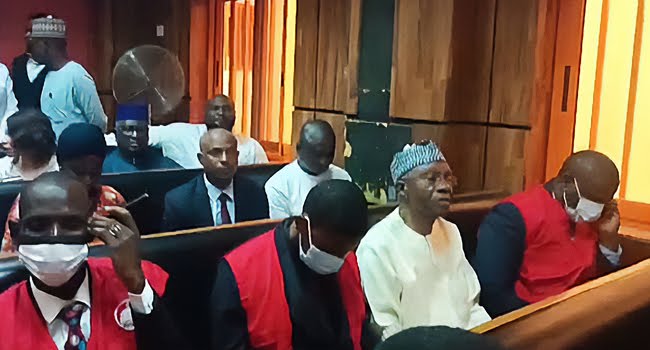
David Jaiyeoba, a witness of the Economic and Financial Crimes Commission (EFCC), has told the Federal Capital Territory (FCT) high court in Abuja that $2.045 million in cash and several property documents were traceable to Godwin Emefiele, former governor of the Central Bank of Nigeria (CBN).
During her testimony in the current trial, Jaiyeoba, the 12th prosecution witness and an EFCC agent, connected the money and property purchases to bank transactions, approvals, and statements gathered during the commission’s inquiry.
The witness, led in testimony by Rotimi Oyedepo, EFCC head of public prosecutions, cited multiple CBN internal memos authorizing payments for the refurbishment, landscaping, power supply, and furnishing of the former Apex Bank governor’s private property in Ikoyi, Lagos.
The witness informed the court that a number of documents, including an internal CBN memorandum authorizing payments to Architeco Nigeria Limited for renovations in Emefiele’s home, were displayed as exhibits.
A contract agreement outlining the landscaping services performed at the Ikoyi property by the same company was also submitted.
He also cited another internal CBN memo that requested permission to pay N97,998,416.38 to Architeco Nigeria Limited for office equipment, stressing that Emefiele had granted the request.
Furthermore, exhibit A8, according to the witness, is an internal memo related to a contract for the installation of specialized electricity lines at the Ikoyi property. He stated the document had the defendant’s consent and was supported by an interim payment certificate.
Additionally, Jaiyeoba informed the court that the EFCC contacted Zenith Bank to follow up on the defendant’s bank account as part of the investigation.
Regarding Emefiele’s account, he recognized Exhibits ED1, ED2, and ED3 as answers from Zenith Bank.
The witness claimed that on January 13, 2015, a debit transaction on account number 2020000064 showed an N4 million payment to Architeco Nigeria Limited.
The investigation resulted in the recovery of $2.045 million, multiple properties, and title papers from the Lagos offices of Zenith Bank Plc, the court was further informed.
“My Lord, the $2,045,000 in funds, along with a number of properties and title documents, were found in the possession of Mr. Collins Omeke, the defendant’s attorney, at the Zenith Bank Plc headquarters in Lagos,” he declared.
He stated that Omeke told investigators he had been purchasing houses and preparing title paperwork on the directions of the defendant.
“He confirmed that the defendant was in the habit of giving him cash sums in foreign currency, specifically US dollars, for the acquisition of those properties when asked how he funded these acquisitions, My Lord,” the witness said.
The witness further informed the court that Omeke claimed that Eric Ocheme Udoh had handed the money that had been recovered from him on behalf of the defendant, and that some of the money had been utilized to refurbish portions of Emefiele’s property.
The prosecution requested at the conclusion of the session that the court postpone the trial until March 3, 5, 16, and 17, 2026.
Matthew Burkaaa, defence counsel, did not oppose the application but argued there was repetition of evidence, adding that an earlier witness, PW7, had already identified approvals pertaining to the transactions.
He cautioned that if the pattern persisted in later sessions, the defense will raise objections.
In response, the prosecution asked the court to let it present its evidence however it saw proper, arguing that the consistency of its case justified the strategy.
The trial judge, Hamza Muazu, expressed worry in his remarks that the prosecution seemed “too careful” and frequently needed the court’s encouragement, but he promised to make accommodations.
As a result, he postponed the case to March 5, 16, and 17, 2026, to continue the trial.