🌿 Ruzu Non-Alcoholic Herbal Bitters
Ruzu Non-Alcoholic Herbal Bitters is a natural health supplement specially formulated to:
- ✅ Promote general wellness
- ✅ Detoxify the body
- ✅ Support the treatment of various ailments
Made from a powerful blend of 100% organic and medicinal herbs, Ruzu is completely alcohol-free, making it ideal for:
- 👪 All age groups
- 🌱 Health-conscious individuals
- 🌿 Anyone seeking non-alcoholic herbal remedies
Whether you're looking to boost your vitality, cleanse your system, or support healing the natural way, Ruzu Bitters offers a trusted herbal solution.
The Federal Government cautioned on Wednesday against using casual language in public discourse, media, and security because imprecise definitions could widen rifts and weaken national cohesion.
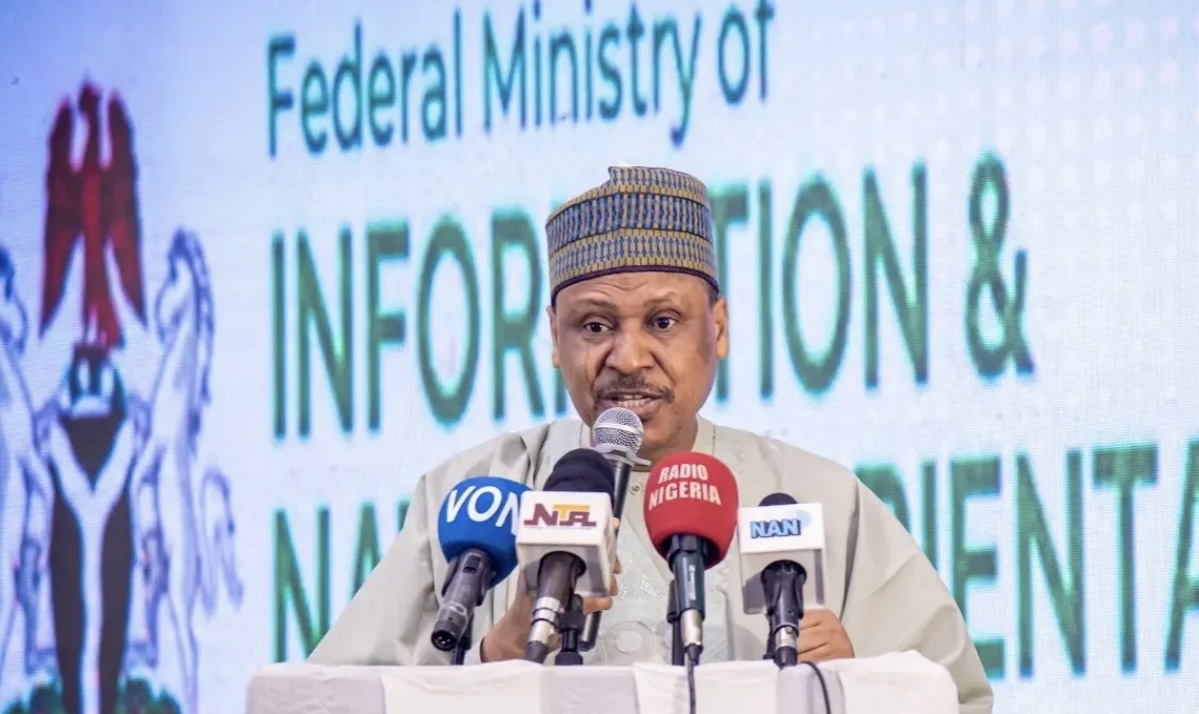
At a two-day seminar on “Contextualizing Definitions and Terminologies to Address Stereotyping and Ethnic Profiling in Discourses and Security Operations in West Africa,” Mohammed Idris, Minister of Information and National Orientation, issued the caution in Abuja.
The Whiteink Institute for Strategic Education and Research (WISER) and BEACON Security and Intelligence Limited jointly organized the conference with the goal of advancing inclusion and professionalism in security operations.
Additionally, SPRING, UK International Development, and the Institute for Peace and Conflict Resolution (IPCR) support it.
Idris was represented by Dr. Dili Ezughah, Executive Secretary of the Nigerian Press Council (NPC), who pointed out that language used to describe security risks and impacted areas might have weight and repercussions.
He claims that terms and labels used in public discourse, media coverage, and security activities can affect how communities are perceived and handled, as well as strengthen or widen divisions.
He used the experience of Nigeria, which has hundreds of ethnic groups and various religious traditions, as an illustration of how managing diversity calls for discipline and justice in communication and policy.
The minister emphasized that trust is just as important to security as power and enforcement, saying that residents must be viewed as collaborators in the fight against security threats.
He pointed out that Nigeria was bolstering its security architecture to counteract these threats and that the country was now dealing with complicated security issues, including as organized crime and terrorism.
In order to avoid categorizing entire populations, he demanded that language be accurate, that people take responsibility for their acts, and that criminal behavior and identity be distinguished.
Idris also emphasized the importance of regional cooperation in addressing common security issues and the vital role that the media plays in encouraging responsible reporting and verifiable information.
In his welcome speech, Maj-Gen. Adamu Laka, National Coordinator of NCTC, Office of the National Security Adviser (ONSA), pointed out that the way security concerns were defined, explained, and conveyed could either improve community cohesiveness or increase mistrust.
“The language we choose to describe security risks and impacted groups can have serious implications.
Because it immediately affects legitimacy and trust, “responsible terminology is therefore an operational necessity,” Laka stated.
He emphasized that preventive, trust-building, and responsible communication were necessary to establish sustainable security rather than relying solely on kinetic tactics.
Laka reiterated the NCTC’s dedication to backing programs that encouraged professionalism, diversity, and appropriate communication in the field of security.
Speaking as well, Dr. Joseph Ochogwu, Director-General of IPCR, urged sufficient funding and capacity building for regional players to deal with the nation’s conflict and violent problems.
“We need to strengthen the ability of our local actors because, just as conflict and violence are local, so is peace, and the people are essential to it. He stated, “We must not cut off the people.
Lt-Gen. Waidi Shaibu, the Chief of Army Staff (COAS), was asked by Maj.-Gen. Umaru Yusuf to engage in thoughtful and fruitful conversations in order to develop more effective tactics for resolving conflicts, fostering peace, and improving security.
He urged participants to use the opportunity to create alliances and spearhead projects that would have a long-lasting effect on combating ethnic profiling and stereotyping in discourse and security operations.
Dr. Ukoha Ukiwo, Team Lead for the Splendid Peace and Resilience in Nigeria Programme (SPRiNG), on behalf of British High Commissioner Richard Montgomery to Nigeria, promised the commission’s support for peacebuilding in Nigeria.
As part of this general, long-standing support, the UK government has collaborated with the Nigerian government to create the SPRING, which will work with Nigerian institutions and actors to support efforts at nonviolent conflict resolution and to improve adaptation and resilience to the pressures of climate change.
He stated, “The SPRING program is an evidence-based program on what research has found to be the issues that drive violence and undermine resilience in Nigeria.”
Retired Brig.-Gen. Saleh Bala, President and Founder of WISER, cautioned that labels and terminologies used to describe crimes and ethnic groups could create preconceptions and promote violence.
“You’re only addressing the symptoms when you apply labels that are stereotyping and profiling, rather than the root of the problem,” Bala stated.
He emphasized how important it is to comprehend the anthropological and historical backgrounds of names and labels.
He emphasized that it was the duty of elites to encourage responsible communication and to become aware of the harm caused by the use of careless, general terms.
In order to create a more peaceful society, he claimed that the conference would assist in raising elites’ understanding of the risks associated with employing language that could fuel prejudice and violence.
In the meantime, President Bola Tinubu will go to Jos, the capital of Plateau State, today in preparation for a planned four-state tour of the nation.
It is anticipated that the president will express sympathy to the Plateau administration and people regarding the recent gun attacks that killed innocent civilians.
His originally scheduled trip to Iperu, Ogun State, where he was supposed to launch operations at the Gateway International Cargo Airport, was postponed in favor of this visit.
This was said in a statement released on Wednesday in Abuja by Mr. Bayo Onanuga, the presidential spokesperson.
The visit demonstrates the administration’s sympathy with the state’s impacted residents and its concern for security issues.
To celebrate Good Friday, the President would travel from Plateau to Lagos.
Tinubu will visit Ogun State on Saturday to officially open the Gateway International Cargo Airport. He will also officially open two commercial aircraft that will be used for import and export activities in an effort to accelerate the state’s economic development.
The Nigeria Customs Service’s Federal Operations Unit’s new building is to be inaugurated by the President during the Ogun visit.
In order to improve the service’s effectiveness in managing borders and facilitating trade, he will also launch operational vehicles.
After that, Tinubu would go back to Lagos to continue the Easter break and attend other official functions.
Key infrastructure projects carried out by Gov. Babajide Sanwo-Olu’s government are anticipated to be commissioned by the President while in Lagos.
These include a multi-agency complex named after the president, the Lagos State Geographic Information System Building, and the Ojota/Opebi Link Bridge.
In addition, he will open a school complex as part of the state’s attempts to upgrade its educational facilities.
Tinubu would travel to Bayelsa on April 10 to commission projects before heading back to Abuja.
The projects were finished by Governor Duoye Diri’s administration.
It is anticipated that the four-state journey will include both commissioning of infrastructure projects in various sectors and condolence visits.