🌿 Ruzu Non-Alcoholic Herbal Bitters
Ruzu Non-Alcoholic Herbal Bitters is a natural health supplement specially formulated to:
- ✅ Promote general wellness
- ✅ Detoxify the body
- ✅ Support the treatment of various ailments
Made from a powerful blend of 100% organic and medicinal herbs, Ruzu is completely alcohol-free, making it ideal for:
- 👪 All age groups
- 🌱 Health-conscious individuals
- 🌿 Anyone seeking non-alcoholic herbal remedies
Whether you're looking to boost your vitality, cleanse your system, or support healing the natural way, Ruzu Bitters offers a trusted herbal solution.
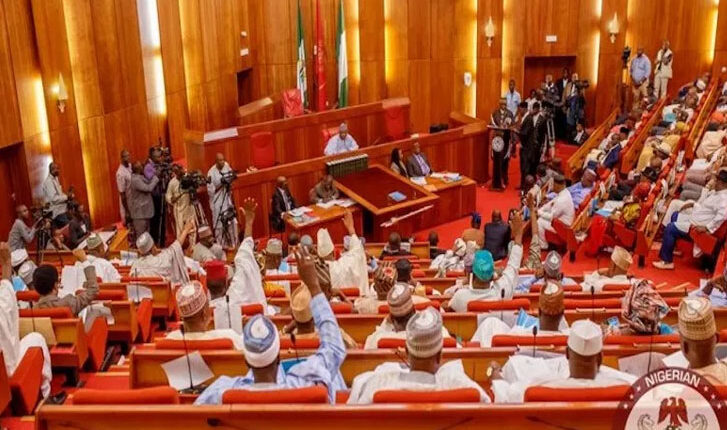
As part of consultations on Nigeria’s economic outlook and the ongoing reform initiatives under Bola Tinubu’s administration, the Nigerian Senate leadership is scheduled to meet at a high level with representatives of the International Monetary Fund (IMF).
According to reports, the interaction is a component of the IMF’s Article IV Consultation with Nigeria, which is a regular evaluation of a nation’s financial stability, economic policies, and reform initiatives.
As the government pursues its extensive economic reforms, the meeting is anticipated to give parliamentarians a clearer understanding of the Federal Government’s framework for economic management and to investigate possible areas of support that the IMF could provide.
Barau Jibrin, the Senate Deputy President, revealed the intended engagement.
He claims that the IMF’s team will meet with important government institutions and stakeholders in Nigeria from March 4 to March 17, 2026.
“The Federal Office of Finance wishes to inform the leadership of the Senate and distinguished senators that, at the instance of the Federal Government of Nigeria, the International Monetary Fund Article IV Consultation in Nigeria has been scheduled to hold from March 4 to March 17, 2026,” the notice stated in part.
The letter also disclosed that, as part of the consultation process, the IMF expressly asked for a high-level meeting with the Senate leadership.
It is anticipated that the gathering will provide a forum for discussion between legislators and IMF representatives regarding Nigeria’s economic trajectory, policy changes, and methods for bolstering macroeconomic stability.
The impact of the Federal Government’s monetary and fiscal changes as well as the overall outlook for the Nigerian economy are anticipated to be the main topics of discussion during the consultations.
Global financial institutions have characterized Nigeria’s economic prognosis for 2025 as gradually improving but still precarious.
After a period marked by high inflation, volatile currency rates, and low oil production, the country’s economy is starting to stabilize thanks to recent economic reforms and incremental macroeconomic adjustments, according to the World Bank and the International Monetary Fund.
The IMF predicted that Nigeria’s GDP will expand by roughly 3.4% in 2025, indicating a little increase as economic activity picks up, especially in non-oil sectors.
The organization cautioned that the outlook is still limited by ongoing inflationary pressures, financial difficulties, and structural constraints, such as problems with infrastructure and energy supplies.
In a similar vein, the World Bank predicted that between 2025 and 2026, Nigeria’s economy may increase by an average of roughly 3.6%.
The Bank claims that measures including tighter monetary policies, exchange-rate unification, and the elimination of fuel subsidies are boosting investor confidence and stabilizing government finances.
The services industry, especially financial and telecommunications services, has been a major driver of economic growth during this time.
International organizations are more optimistic about Nigeria’s economic future.
Nigeria’s GDP prediction was recently raised by the IMF to roughly 4.4% in 2026, indicating hopes that continued monetary and fiscal reforms will progressively improve macroeconomic stability and productivity.
In a similar vein, the World Bank predicted that Nigeria’s GDP may increase by about 4.4% in 2026 and 2027, which might be the fastest growth rate in the nation in over ten years.
As the nation steps up attempts to diversify its economy, services, agriculture, and non-oil industries are likely to fuel the projected growth.
Olayemi Cardoso, the governor of the Central Bank of Nigeria (CBN), stated on Thursday that Nigeria’s continuous macroeconomic reforms have put the nation’s economy in a position to weather any shocks brought on by the mounting tensions in the Middle East.
Cardoso made this claim while giving a Distinguished Alumni Lecture at St. Gregory’s College in Lagos on Founders’ Day.
He pointed out that geopolitical tensions, especially the developing crises involving the United States, Israel, and Iran, are causing fresh concerns for the world economy.
He claims that the situation may lead to increased risk aversion among foreign investors, interruptions in global supply networks, and higher energy costs.
However, Cardoso insisted that Nigeria’s macroeconomic buffers have been strengthened by economic reforms implemented during the last two years, putting the nation in a better position to withstand possible external shocks.
“Today, the global economy is facing renewed shocks, including ongoing geopolitical tensions and developments in the US-Israel-Iran conflict,” he stated. These occurrences could raise energy costs, interfere with supply networks, and make investors around the world more risk averse.
However, Nigeria is now in a far better position to handle these difficulties thanks to the macroeconomic reforms and policy buffers we have developed over the last two years. Our home will withstand the storms.
The governor of the nation’s top bank also revealed that the central bank’s policy changes have improved the liquidity and efficiency of the nation’s foreign exchange market.
He claims that the bank’s intentional policy actions have restored investor confidence while assisting in the removal of foreign exchange market inefficiencies.