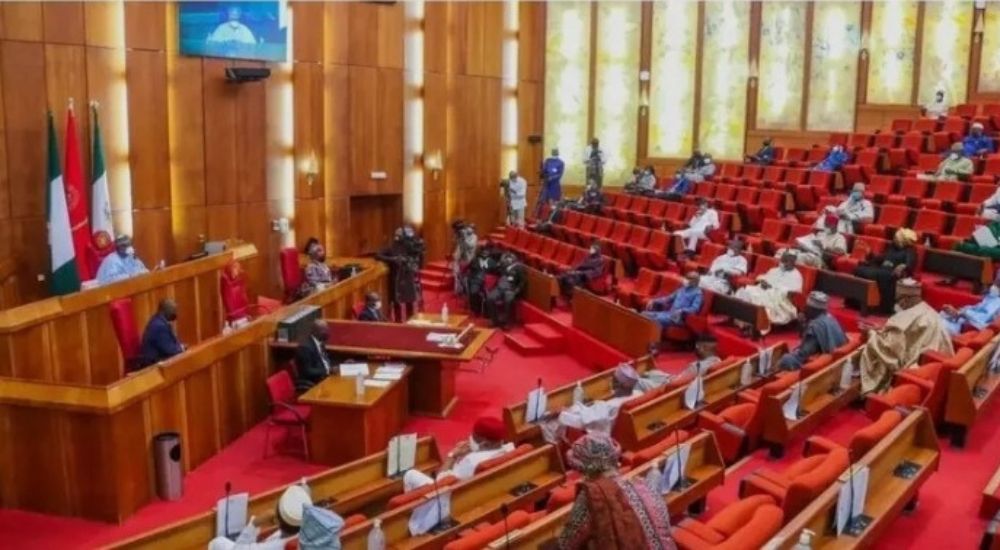
The Nigerian Senate has shown courage in changing its leadership structure ahead of the 2027 general elections that will usher in the 11th National Assembly.
The new structure would usher in stricter eligibility rules that could turn back a wave of incoming political heavyweights including sitting governors and first-time entrants.
After a nearly three-hour closed-door session Tuesday, the red chamber amended key provisions of its Standing Rules on Tuesday’s plenary. The changes, which impact Orders 4 and 5, enhance the role of seniority and legislative experience as the primary criteria for occupying top leadership positions.
The Senate reaffirmed a rigid hierarchy for selecting presiding officers in the amended Order 4, saying “nomination of senators to serve as Presiding Officers shall be in accordance with the ranking of senators and shall be strictly adhered to.”
“The order of ranking are (i) Former President of the Senate, (ii) Former Deputy President of the Senate, (iii) Former Principal Officers of the Senate, (iv) Senators who had served at least one term of four years, (v) Senators who had been members of the House of Representatives, (vi) In the absence of i to v, senators elected into the Senate for the first time,” it said.
Another change in Order 5 is the more restrictive requirement that excludes newcomers and those who do not have continuous legislative experience from competing for the main offices.
The rule reads: “Any senator shall not be eligible to contest for any principal office of the Senate unless he has served as a senator for at least two consecutive terms immediately preceding nomination.
This clause has far-reaching implications. Those who are not in the 9th and 10th National Assembly will not be eligible to contest for key leadership positions like Senate President, Deputy Senate President, Senate Leader, Chief Whip and other principal positions.
The move is coming on the heels of rising interest by outgoing governors and political heavyweights who are eyeing senatorial slots in the 2027 General Elections.
By May 29, 2027, at least ten governors across the country will have served their two terms allowed by the constitution, sparking a flurry of political realignments as they seek to remain relevant at the national level.
Among those widely speculated to be eyeing senatorial seats are Governors AbdulRahman AbdulRazaq of Kwara State, Abdullahi Sule of Nasarawa State, Ahmadu Fintiri of Adamawa State, Babagana Zulum of Borno State, Inuwa Yahaya of Gombe State, Mai Mala Buni of Yobe State, Babajide Sanwo-Olu of Lagos State and Dapo Abiodun of Ogun State.
Others include Oyo State Governor, Seyi Makinde of the Peoples Democratic Party and Bauchi State Governor, Bala Mohammed of the Allied Peoples Movement.
Douye Diri and Hope Uzodimma are set to complete their tenure in 2028, but off-cycle elections have already pulled both into early political calculations around Senate seats.
“The APC is grooming Uzodinma for the senatorial seat for Imo West. Political storm is brewing in Imo State.
State party bosses have reportedly supported him as a consensus candidate. Presenting the nomination forms on behalf of the stakeholders, the state APC chairman, Chief Austin Onyedebelu, urged the governor to accept the call to run, saying “accept the plea of Orlu people by filling the forms so that it can be submitted before the deadline of 5th May, 2026.”
The party is also said to have cautioned other aspirants against contesting the seat, thus consolidating Uzodinma’s position as its preferred candidate.
But the race remains far from over. Former Imo State Governor Rochas Okorocha has also picked up nomination forms, indicating his interest in returning to the Senate.
Uzodinma also gained additional backing from the Orlu Political Consultative Assembly which announced him the sole candidate for the district in what it called a “total, unanimous and irrevocable decision.”
The question of whether the world’s leading nations will be able to pull together enough to solve the global financial crisis has been asked repeatedly over the last few weeks.
The political scene has been further shaped by recent indications from President Bola Ahmed Tinubu who reportedly turned down proposals for automatic return tickets for lawmakers and reaffirmed the power of state governors to choose party candidates.
This has effectively increased the power of governors over party structures, even as they prepare for transitions out of executive office.
In this context, the Senate’s recent rule changes seem to be designed to preserve its institutional hierarchy and prevent a flood of politically influential newcomers from immediately dominating its leadership.
Indeed, the red chamber has sent a clear message to many would-be entrants, including governors and returning political actors, that leadership in the 11th National Assembly will be determined by legislative experience among its members and not political influence from outside.