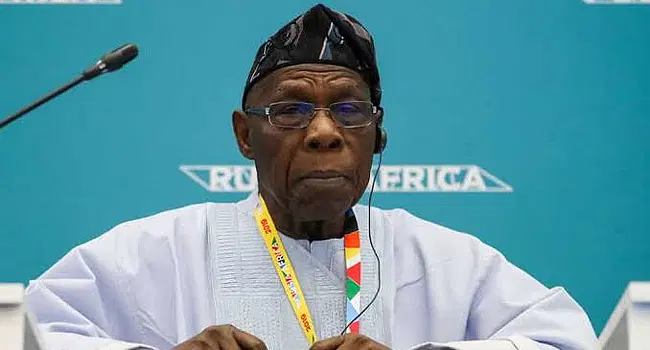
Former President Olusegun Obasanjo has said that any government that doesn’t protect people’s lives and property has no reason to exist. This is a clear sign of Nigeria’s growing insecurity and the problems with its leadership.
Obasanjo said that Nigeria’s problems are getting worse because of bad leadership. He warned that Nigeria has lost its power in world affairs and has messed up important relationships in the region, especially in the Economic Community of West African States (ECOWAS).
Obasanjo also said on News Central’s Soni Irabor Live (SIL) over the weekend that Nigeria was no longer “at the table” of global decision-making. He said that the country’s inability to shape events outside of its borders shows a larger lack of leadership.
The former leader of Africa’s most populous country spoke out against the widespread insecurity in Nigeria and said that people should not accept kidnapping and other social ills as normal. He pointed out that Nigerians used to be able to travel freely across the country.
He gave the federal government a harsh review, saying that any government that doesn’t protect people’s lives and property has lost the right to exist.
Obasanjo said that Nigeria’s security problems got worse after the civil war, when there wasn’t enough control over the spread of weapons. He said that the problem had gotten worse since then because of bad government and lack of attention.
He also said that both outside and inside factors were to blame for the crisis. For example, armed mercenaries came back after Libya’s former leader Muammar Gaddafi fell, and armed groups were used for political purposes.
Obasanjo said that the rising number of children who aren’t in school, which is thought to be around 20 million, is a long-term security threat because it makes it easy for extremist groups to recruit new members.
He said, “The other day, someone came to me and said that from NIPSS (National Institute for Policy and Strategic Studies), they were looking into why there is so much insecurity.” I asked, “What is this about?” He said that the government told them to do this.
“I said, well, this government, do they have the guts to do whatever you tell them to do? He told me he didn’t know. I told them, “Look, I came back to this country in 1959 after my military training in the UK.” You could go anywhere in the North. Everywhere. And what you will get is people being nice there.
“And someone told me the other day that we take kidnapping for granted.” It is no longer news. When you hear that someone in your family has been taken, you all get together. They might let him go for N2,000, though. Is that how we should live our lives? Not a chance.
Obasanjo said, “The first duty of any government, no matter how it comes to power, is to protect life and property.” A government that can’t protect its citizens’ lives and property has lost its right to exist.
When asked about the country’s future under the current leadership, the former president said, “I see nothing.” He was not optimistic about Nigeria’s current direction. He said that the decline of democratic values, such as what he called the replacement of a “selectorate” for a real electorate, had made governance and accountability weaker.
Obasanjo specifically criticized how the Tinubu administration dealt with relations with Niger Republic after the recent coup there, saying that the response was poorly thought out and would hurt decades of regional cooperation that had been carefully built over 50 years.
He said that Nigeria’s actions, such as closing borders, cutting off electricity, and putting financial restrictions in place, hurt the long-standing historical, economic, and cultural ties between the two countries.
Obasanjo remembered that Nigeria and Niger had deep ties, including many family ties across the border. He also said that working together was once very important to Nigeria’s military and strategic interests.
He said that Nigeria’s choices during the recent crisis in Niger showed that the highest levels of government didn’t understand what was going on. He said that Nigeria needs better leadership right now. He said that Nigeria didn’t have to spend much money to keep its power, but it did need clear thinking and strategic engagement, which he thought were not present at the moment.
After the coup in Niger Republic, Tinubu, as chairman of ECOWAS, was thought to have taken a hard line, calling for sanctions, closing borders, and even threatening military action to restore constitutional order.
Critics, including Obasanjo, said that the situation was not handled well and that it hurt long-standing ties with Niger, making the region less cohesive instead of strengthening ECOWAS’s authority.
Eventually, Niger, Mali, and Burkina Faso left the sub-regional group.
Obasanjo said, “Nigeria is not at the table of international politics today.” What is going on that Nigeria is affecting or affecting, and who is Nigeria affecting?
“See how we’ve dealt with ECOWAS. We built this over the course of 50 years. We messed it up overnight. And we’ve pretty much ruined it.
“It’s about leadership. There was a coup in Niger. Our neighbor. At least 30% of the people in Niger Republic are related to people in Nigeria by blood.
“We were working on the Kanji Dam. It would have been silly to use Kanji. So we told Niger Republic, “We’ll give you whatever you want for electricity when the Kanji Dam is working.” We had to do that.
“We wouldn’t have been able to win the civil war without the Niger Republic.” We used to get supplies from Niger Republic and send them to our troops on the front lines. Now, they had to leave because of all of this. The first thing we did was close the border. The next thing we did was turn off their power. After that, we said, “No money.” Because our borders aren’t solid!
“So, when I say mishandling, you can see what I mean,” Obasanjo said. Nigeria doesn’t have to pay much to be at the table. But you have to understand it. But really, I feel bad. Because I know what Nigeria is capable of.
Obasanjo also said that the National Council of State (NCS), which is made up of former presidents who give advice, was not important and that going to its meetings was a waste of time. He said that the body was only an advisory group and that its suggestions were often ignored, which made it useless as a way to get involved or change policy.
The former president said again what he has always said about the economy and the oil sector: that government-owned refineries run by the Nigerian National Petroleum Company Limited (NNPC) would not work well. He said that their ongoing poor performance was mostly due to structural problems, bad maintenance, corruption, and not having enough scale.
He said that while he was in office, there were efforts to get private companies to help run the refineries. For example, he talked to international oil companies like Shell, but they didn’t want to get involved because they were worried about making money and running into problems. He also talked about how billionaire businessman Aliko Dangote tried to buy stakes in the refineries before, but his successor changed his mind.
Obasanjo said that the government had spent billions of dollars, up to $16 billion, on the refineries, but had little to show for it. He compared this to the success of privately run projects like the Nigeria LNG project, which he said showed that public-private partnerships were better.
“Look at what we’re doing now, even with the NNPC. NNPC owns oil refineries. He said, “And I told people it would never work.”
The former president warned against the rise of a one-party state in Nigeria’s political system, saying it would hurt the country’s growth and the health of its democracy. He agreed with the president that he didn’t want Nigeria to be a one-party state, but he said that this system would not be good for Nigeria.
Obasanjo said, “He (Tinubu) said he doesn’t want Nigeria to be a one-party state.” He said that. And, like I said, I will believe him this time. That’s too bad. Because it won’t even do what it was meant to do.
Even though people were critical, Obasanjo was very sure that Nigeria could still get better. He said this was because of the country’s potential and the strength of its people.
He did, however, stress that real progress would depend on a major change in the quality of leadership and the way the government works.