In the ongoing trial of an alleged plot to overthrow President Bola Tinubu, court documents filed by the Federal Government have claimed that the suspected mastermind, Nigerian Army Colonel Mohammed Ma’aji, sought spiritual support from Islamic clerics while allegedly planning the failed coup.
According to Premium Times, the records, which are part of the prosecution’s proof of evidence before the Federal High Court in Abuja and a General Court Martial, alleged that the colonel repeatedly approached clerics for prayers, guidance and support.
But in statements to investigators, the clerics said they always discouraged any attempt to topple the government.
“The allegations in the prosecution’s case are yet to be determined by the court.
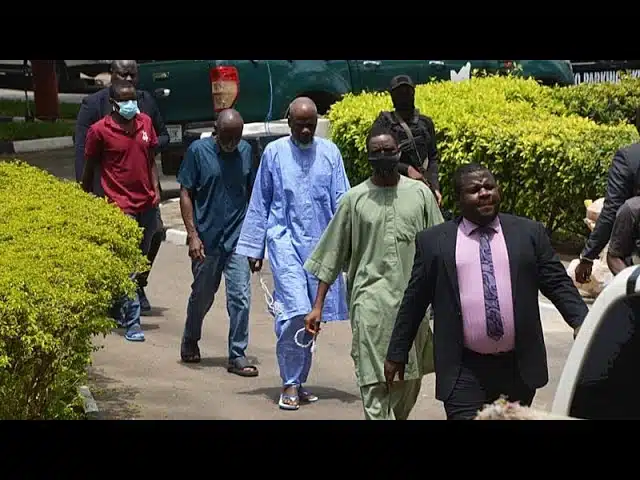
The Federal Government on April 22 arraigned six defendants before the Federal High Court, Abuja, over an alleged plot to carry out a coup in 2025.
The defendants are retired Major General Mohammed Gana, retired Navy Captain Erasmus Ochegobia Victor, Police Inspector Ahmed Ibrahim, Presidential Villa electrician Zekeri Umoru, Bukar Goni and Islamic cleric Abdulkadir Sani who is based in Kaduna.
They face a 13-count charge bordering on treason, terrorism, money laundering and failure to disclose information.
The Office of the Attorney-General of the Federation filed the case FHC/ABJ/CR/206/2026.
Bukar Goni, in his statement to investigators, said he met Ma’aji through Major M.A. Usman after both military officers sought prayers over repeated failures in promotion examinations.
Goni said the colonel, who allegedly sought promotion to the rank of brigadier general, became frustrated at his failure to get promoted and believed senior officers were deliberately frustrating his career.
The cleric stated that he told the officer to continue to pray and do charitable deeds instead of doing unlawful things.
Ma’aji spoke of people planning what he described as a “riot,” but Goni said he turned down the idea every time it came up.
The statement also said the cleric told the officer he would have a disturbing dream, which he took as a sign that any violent action would end in disaster, before he resorted to what he called a spiritual warning.
Goni said the warning convinced the officer to drop the alleged plan — at least for the moment.
The cleric confessed to receiving millions of naira from Ma’aji but maintained that the money was intended only for prayers, charitable activities and building a mosque.
He told investigators that about #10 million was transferred within 15 days while two further transfers of #20 million each were later received.
He said about ₦24.7 million had been spent to acquire land for the mosque, while the rest of the money was being kept for the project.
Read Also: 10th Reps Records 2,747 Bills in Three Years
He denied receiving any money to help an alleged coup.
Another cleric, Abdulkadir Sani, also told investigators that Ma’aji approached him only for prayers during a religious event in Bida.
Later discussions were about the planned uprising after an intermediary allegedly told him about it, Sani said.
The cleric said he warned right away that the operation would fail because two members of the group would betray it in the end.
He further alleged that the colonel later asked for prayers to prevent internal betrayal and later transferred ₦2 million to his bank account.
Sani said his bank account was later blocked and he was arrested when he went to the Economic and Financial Crimes Commission to make enquiries.
The statements by the two clerics are part of the prosecution’s evidence in the ongoing trial.
The prosecution claims they were some of the witnesses interviewed during the probe that involved military officers, police personnel and civilians.
The six defendants have all denied the charges and are contesting the admissibility of their statements.
The court is expected to rule on the allegations on the evidence presented during the trial.